The European Space Agency has decided that is currently impossible to continue any ongoing cooperation with the Russian space agency Roscosmos, and is moving forward with a “fast-track industrial study” to define how the mission can proceed without the Russians on its ambitious ExoMars astrobiology mission.
In a release, ESA said that “as an intergovernmental organization mandated to develop and implement space programs in full respect with European values, we deeply deplore the human casualties and tragic consequences of the aggression towards Ukraine. While recognizing the impact on scientific exploration of space, ESA is fully aligned with the sanctions imposed on Russia by its member states.”
The decision to rethink the mission without the Russians involved came as Roscosmos has also moved to break space ties with ESA by withdrawing personnel from Europe’s Spaceport in French Guiana and putting all ESA missions scheduled for launch by Russian Soyuz rockets on hold. In all, five Soyuz launches of missions — Galileo M10, Galileo M11, Euclid, Earthcare and one other — have been cancelled.
The ESA statement said that the agency has begun looking for potential alternative launch services for those missions, too.
ESA has 22 European member nations and has worked frequently with NASA and the Canadian Space Agency, as well as Roscosmos.

At the same time that the European-Russian space partnership has been put on hold and possibly cancelled, the cooperation between Russia and the NASA, ESA, the Japanese Space Agency and the Canadian Space Agency has continued on the International Space Station.
There was earlier some doubt about Russian participation on the ISS after Roscosmos director general Dmitry Rogozin threatened to pull out of the space station and allow it to fall back to Earth in an uncontrolled deorbit to protest of international sanctions on Russia for its Ukraine invasion.
NASA Administrator Bill Nelson pointed to Russia’s plan to launch three cosmonauts to the ISS as evidence of its desire to continue cooperating with the U.S. and others on the station. The three successfully took off from Baikonur (Kazakhstan) on Friday.
Nelson told AP that director general Rogozin “spouts off every now and then. But at the end of the day, he’s worked with us.”
“The other people that work in the Russian civilian space program, they’re professional. They don’t miss a beat with us, American astronauts and American mission control.”
While the Russian involvement in the ISS appears to be continuing, Roscosmos said well before the Ukraine invasion that Russia may leave the long-lived space station in 2024.
But for now it appears that little has changed. Russia still plans to take the first space tourist on a space walk from the ISS in 2023.
The ExoMars mission has been plagued by seemingly endless financial, technological and now geopolitical obstacles.
Initially an ESA-NASA-Russian project, the American participation was ended in 2013 when President Obama terminated its participation due to budgetary cuts in order to pay for the cost overruns of the James Webb Space Telescope. With NASA’s funding for the project completely cancelled, plans had to be restructured and the Russians took on a larger role.
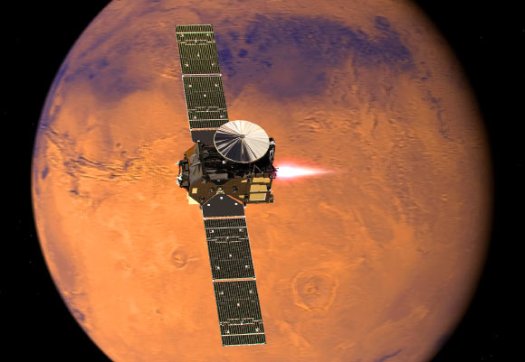
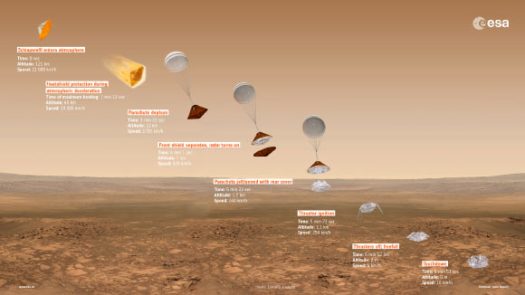
The first of two ExoMars launches took place in 2016 and included the Trace Gas Orbiter — which circles Mars to study atmospheric gases — and the Schiaparelli lander. That spacecraft crashed into the Martian surface.
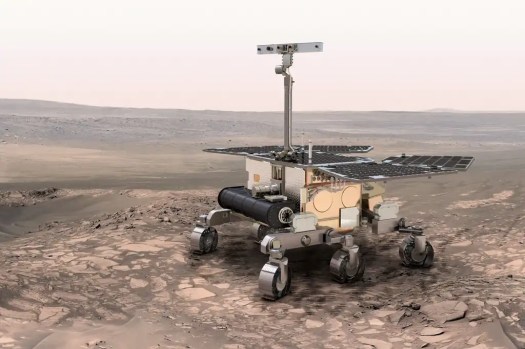
The second ExoMars launch was scheduled for this summer. The goal has been to land a rover, named Rosalind Franklin and construction primarily by England and Canada, on Mars to search for signs of life present and past. The mission was planned to include a Russian launch and also a Russian landing module, the Kazachok, or “Little Cossack.”
As part of the Russian participation in ExoMars, the Russian Academy of Science would have full access to all research data collected.
The new ESA statement about ExoMars announced of a suspension of relations with Roscosmos. But since it also spoke of looking for alternative ways to move the mission forward, it may be the end of ESA-Roscosmos relations on the project.
 Many Worlds