In its more than a decade of exploring Gale Crater on Mars, the rover Curiosity has found innumerable signs of the presence of long-ago water.
There have been fossil streams, alluvial fans, lakes shallow and deep, deltas and countless examples of rocks infiltrated and chemically transformed in the presence of water. The picture of the crater as a watery environment in the warmer and wetter days of Martian history — 4 billion to 3 billion years ago — is well established.
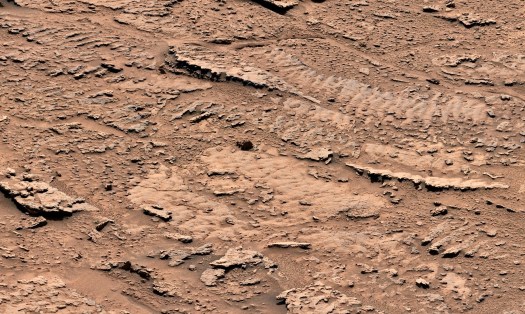
Nonetheless. it still came as a wonder that the rover came across the entirely unexpected remains of fossilized ripples in a shallow lake bed. What was even more surprising is that it was found in an area previously determined to have little likelihood of having ever been wet.
“Billions of years ago, waves on the surface of a shallow lake stirred up sediment at the lake bottom, over time creating rippled textures left in rock,” NASA said in a statement last week.
It was the first time such a feature has been discovered in Gale Crater, although the rover has passed through numerous fossil lake beds.
One of the mission’s main goals has been to find out if this area in the southern highlands of Mars might have once been habitable for microbial life.
It was determined within the first two years of the rover’s time in Gale Crater that the crater was indeed once habitable based on the past presence of significant amounts of water and chemicals left behind by that long-departed water. Understanding the crater’s history of water has been a central goal of the mission.
The Curiosity team was thrilled by their new find.
“This is the best evidence of water and waves that we’ve seen in the entire mission,” said Curiosity project scientist Ashwin Vasavada. “We climbed through thousands of feet of lake deposits and never saw evidence like this.”
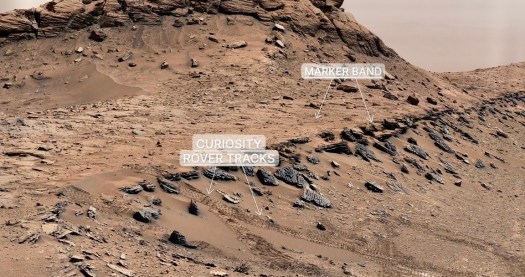
The rippled fossils are in an area set off by a black, hard-rock line called the “Marker Band.” The rock layer is so hard that Curiosity hasn’t been able to drill a sample from it despite several attempts. The same has happened in the rippled lake-bed area.
It’s not the first time Mars has been unwilling to share a sample: Lower down the mountain, on “Vera Rubin Ridge,” the Curiosity drill had to try three times before finding a spot soft enough to produce a powdery sample.

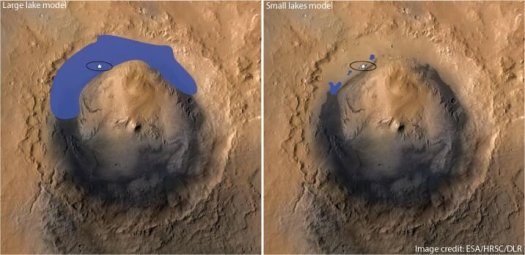
Although it is now clear that there was a fair amount of water on Mars during its early days, the water story on Mars remains scientifically unsettled. The dispute centers around how warm Mars may have once been and for how long.
Some have used Curiosity and other data to argue that Mars was quite frosty during that 3-to-4 billion-year period when water features were carved and deposited, with intermittent warmer spells of thousands of years — perhaps occasioned by volcanoes. They argue that remnant signatures of the greenhouse gases that would be necessary to warm the planet have not been found, so it is unlikely to impossible for Mars to have been warm for long periods of time.
Others have argued for a more consistent and warmer early Mars, where liquid water ran freely and a great Northern Ocean may have been present. These theories suggest that both drizzle and even heavy rains sometimes occurred while the planet was kept warm enough by ice water clouds in the atmosphere and perhaps other molecules that can form protective haze. And then there’s all the global heat from those volcanoes. Mars researchers on the more wet and warm side of the argument nonetheless also say the planet was relatively arid.
While Mars was clearly once warmer and wetter than today — based on geologically and chemically consistent findings — a time came when the planet became much colder.
Scientists suggest that the change had to do with a substantial thinning of the Martian atmosphere after protective magnetic fields dissipated and the solar wind stripped away much of the atmosphere. Indeed, when the rover arrived at the “sulfate-bearing unit” last fall, scientists thought they’d seen the last evidence that lakes once covered this region of Mars.

That’s because the rock layers there formed in drier settings than regions explored earlier in the mission. The area’s sulfates – salty minerals – are thought to have been left behind when water was drying to a trickle.
“We’re seeing evidence of dramatic changes in the ancient Martian climate,” Vasavada said then in a release. “The question now is whether the habitable conditions that Curiosity has found up to now persisted through these changes. Did they disappear, never to return, or did they come and go over millions of years?”
That was said before the rover came across the rippled bedrock of an ancient shallow lake, even further up the mountain. So Curiosity’s team was more than surprised to discover the mission’s clearest evidence yet of ancient water ripples that formed within lakes, because it was in a region they expected to have always been dry.
Such are the many mysteries of Mars
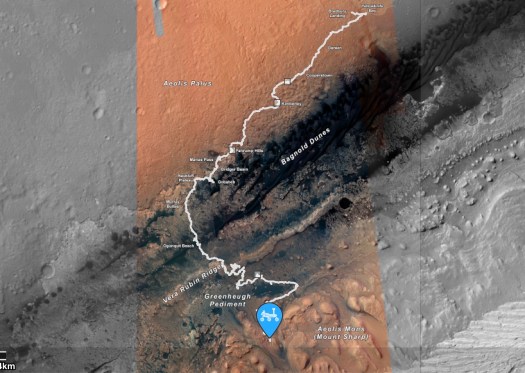

Next stop:
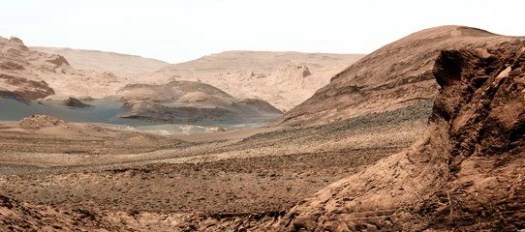
Curiosity will next be headed to a pile of boulders and debris that sit at the far end of the Gediz Vallis.
The material is thought to have come from higher up Mount Sharp, at elevations that Curiosity cannot reach, making them some of the youngest features on the mountain.
So sampling those rocks can give the team a better understanding of conditions further up the mountain and why, when Mars had entered into a far more dry period, there was still water present to create wet landslides.
“The wave ripples, debris flows….all tell us that the story of wet-to-dry on Mars wasn’t simple,” Vasavada said. “Mars’ ancient climate had a wonderful complexity to it, much like Earth’s.”
 Many Worlds