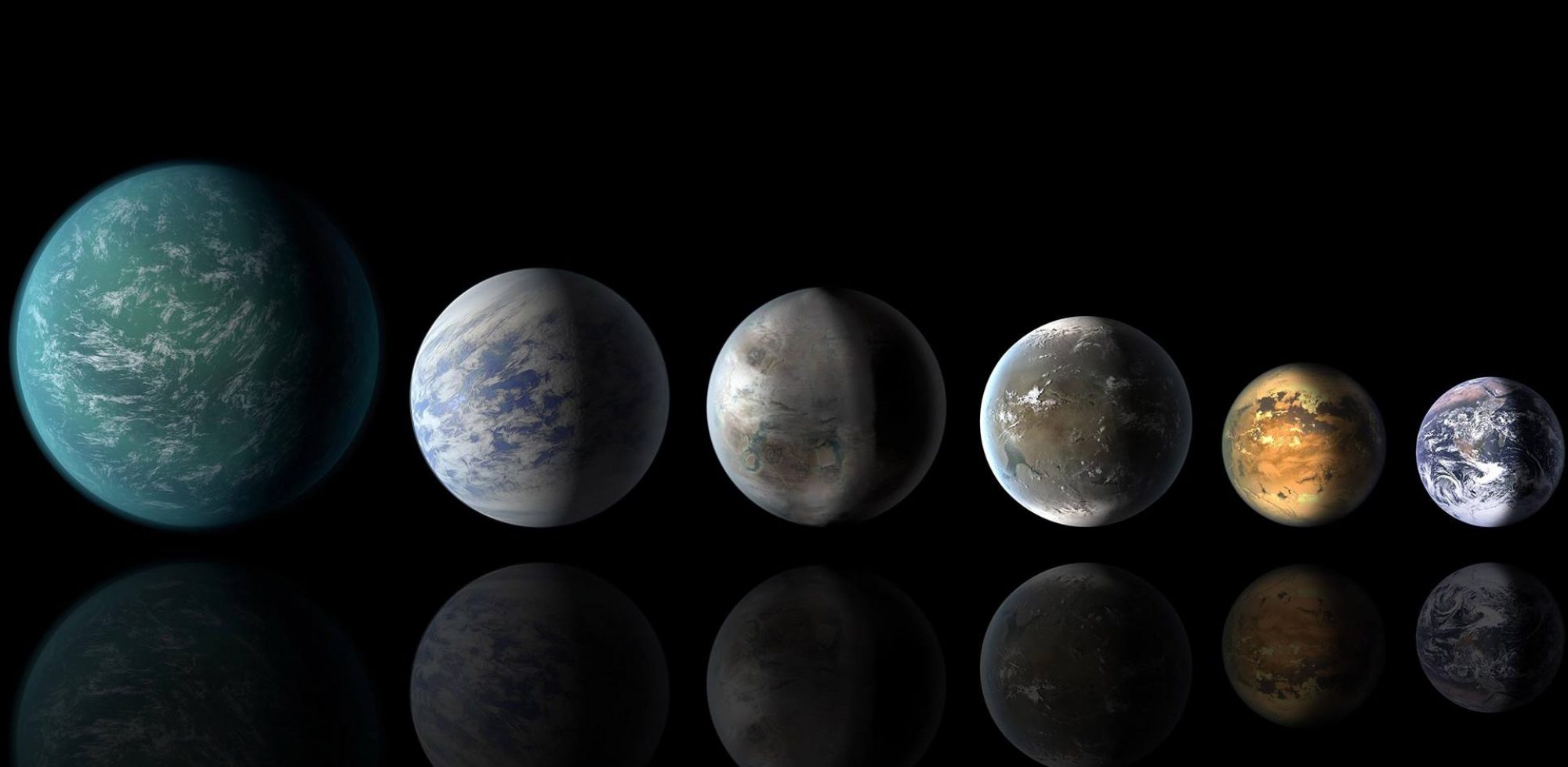
One of the richest lines of research for those thinking about life beyond Earth has been the world of microscopic creatures that live in especially extreme and hostile environments here. The realm of extremophiles has exploded in roughly the period that exoplanet discoveries have exploded, and both serve to significantly change our view of what's …
Retro Exo and Its Originators
Exoplanets are mysterious, they're complicated, they're important, they're awe-inspiring. And, to a team of artists at the Jet Propulsion Lab, they're also totally fun. They're a topic for endless artistic creation because they're that remarkable combination of brand new and, surprisingly, comfortably familiar. Exoplanets may be weird and wild but they're also potentially home …
France and Exoplanets
For reasons all too regrettable, it seems appropriate today to highlight the extensive work being done in France and by French scientists to move forward the science of exoplanets. The American public tends to view space observatories and exoplanet research as largely the domain of NASA and our nation. While we are leaders for sure, …
On Super-Earths, Sub-Neptunes and Some Lessons They Teach
Part 2 of 2 With such a large proportion of identified exoplanets in the super-Earth to sub-Neptune class, an inescapable question arises: how conducive might they be to the origin and maintenance of life? So little is actually know about the characteristics of these planets that are larger than Earth but smaller than Neptune …
Continue reading "On Super-Earths, Sub-Neptunes and Some Lessons They Teach"
On Super-Earths, Sub-Neptunes and Some Lessons They Teach
Part 1 of 2 When the first exoplanet was identified and confirmed 20 years ago, there was enormous excitement, a sense of historic breakthrough and, with almost parallel intensity, sheer bewilderment. The planet, 51 Pegasi B, was larger than Jupiter yet orbited its parent star in 4 days. In other words, it was much closer …
Continue reading "On Super-Earths, Sub-Neptunes and Some Lessons They Teach"
Counting Our Countless Worlds
Imagine counting all the people who have ever lived on Earth, well over 100 billion of them. Then imagine counting all the planets now orbiting stars in our Milky Way galaxy , and in particular the ones that are roughly speaking Earth-sized. Not so big that the planet turns into a gas giant, and not so …
The Exoplanet Era
Throughout the history of science, moments periodically arrive when new fields of knowledge and discovery just explode. Cosmology was a kind of dream world until Edwin Hubble established that the universe was expanding, and doing so at an ever-faster rate. A far more vibrant and scientific discipline was born. On a more practical level, it …
 Many Worlds