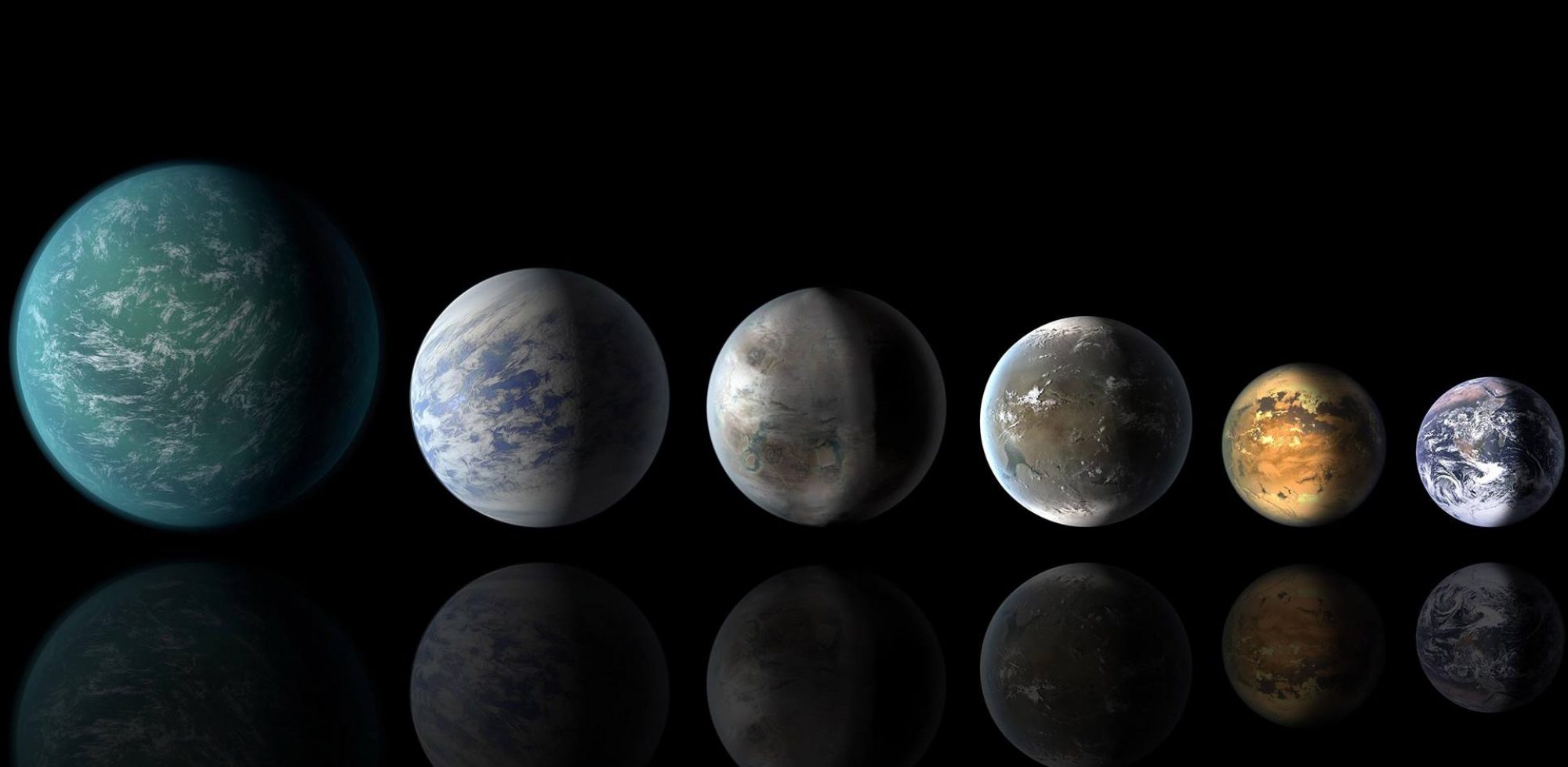
The Hubble Space Telescope, arguably the jewel in the crown of NASA's science missions, was launched 29 years ago. It has been providing scientists and the public with a steady stream of previously unimagined insights about the cosmos -- plus those jaw-dropping, very high-resolution images like the one above -- pretty much ever since. It …
The “Twin Study,” and What it Does and Does Not Say About The Health Hazards of Space Travel
When Buzz Aldrin became the second man to ever walk on the moon, his lunar escapades, along with those of Neil Armstrong, were a cause of national and pretty much global joy, wonder and pride. That the mission was hazardous was self-evident -- from launch to the ad-lib and hair-raising landing on the moon, …
How Creatures End Up Miles Below the Surface of Earth, and Maybe Mars Too
When scientists speculate about possible life on Mars, they generally speak of microbial or other simple creatures living deep below the irradiated and desiccated surface. While Mars long ago had a substantial period that was wetter and warmer when it also had a far more protective atmosphere, the surface now is considered to be …
Continue reading "How Creatures End Up Miles Below the Surface of Earth, and Maybe Mars Too"
All About Emergence
If there was a simple meaning of the often-used scientific term “emergence,” then 100-plus scientists wouldn’t have spent four days presenting, debating and not infrequently disagreeing about what it was. But as last month’s organizers of the Earth-Life Science Institute’s “Comparative Emergence” symposium in Tokyo frequently reminded the participants, those debates and disputes are …
The Gale Winds of Venus Suggest How Locked Exoplanets Could Escape a Fate of Extreme Heat and Brutal Cold
More than two decades before the first exoplanet was discovered, an experiment was performed using a moving flame and liquid mercury that could hold the key to habitability on tidally locked worlds. The paper was published in a 1969 edition of the international journal, Science, by researchers Schubert and Whitehead. The pair reported that …
Artifacts In Space
All of a sudden, we have spacecraft and objects both coming into our solar system and leaving for interstellar space. This is highly unusual, and very intriguing. The departing spacecraft is Voyager 2, which launched in 1977 and has traveled spaceward some 11 billion miles. It has now officially left the heliosphere, the protective …
The Kepler Space Telescope Mission Is Ending But Its Legacy Will Keep Growing.
The Kepler Space Telescope is dead. Long live the Kepler. NASA officials announced on Tuesday that the pioneering exoplanet survey telescope -- which had led to the identification of almost 2,700 exoplanets -- had finally reached its end, having essentially run out of fuel. This is after nine years of observing, after a malfunctioning …
Continue reading "The Kepler Space Telescope Mission Is Ending But Its Legacy Will Keep Growing."
Technosignatures and the Search for Extraterrestrial Intelligence
The word "SETI" pretty much brings to mind the search for radio signals come from distant planets, the movie "Contact," Jill Tarter, Frank Drake and perhaps the SETI Institute, where the effort lives and breathes. But there was a time when SETI -- the Search for Extraterrestrial Intelligence -- was a significantly broader concept, that …
Continue reading "Technosignatures and the Search for Extraterrestrial Intelligence"
15,000 Galaxies in One Image
Here's an image to fire your imagination: Fifteen thousand galaxies in one picture -- sources of light detectable today that were generated as much as 11 billion years ago. Of those 15,000 galaxies, some 12,000 are inferred to be in the process of forming stars. That's hardly surprising because the period around 11 billions years …
A New Frontier for Exoplanet Hunting
The first exoplanets were all found using the radial velocity method of measuring the "wobble" of a star -- movement caused by the gravitational pull of an orbiting planet. Radial velocity has been great for detecting large exoplanets relatively close to our solar system, for assessing their mass and for finding out how long …
 Many Worlds