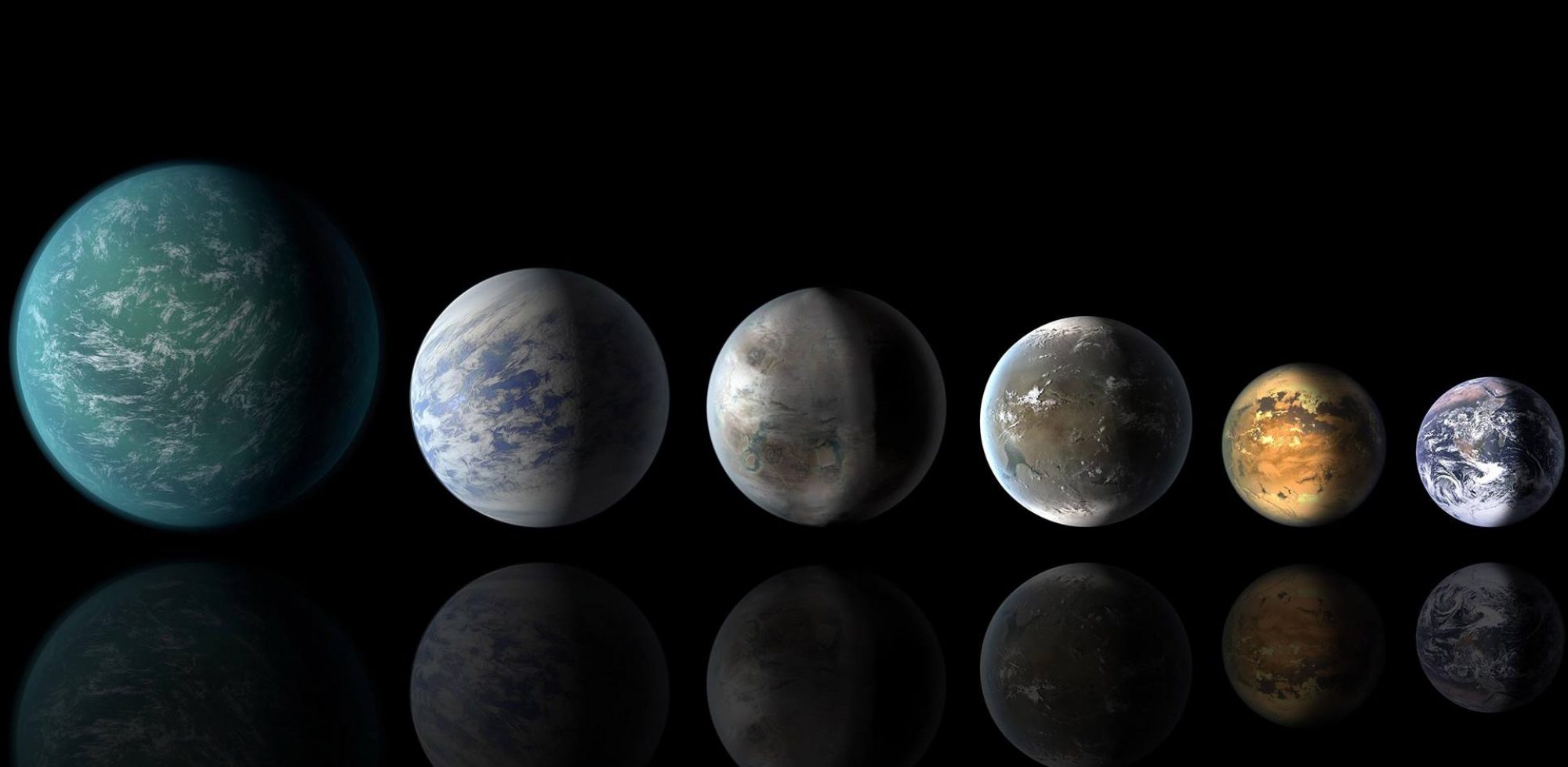
Just about everything that scientists see as essential for extraterrestrial life -- carbon, hydrogen, oxygen, nitrogen, phosphorus, sulfur and sources of energy -- is now known to be pretty common in our solar system and beyond. It's basically there for the taking by untold potential forms of life. But what is not at all common …
Mapping Titan, the Most Earth-Like Body in Our Solar System
Saturn's moon Titan has lakes and rivers of liquid hydrocarbons, temperatures that hover around -300 degrees Fahrenheit, and a thick haze that surrounds it and has cloaked it in mystery. An unusual place for sure, but perhaps what's most unusual is that Titan more closely resembles Earth of all the planets and moons in our …
Continue reading "Mapping Titan, the Most Earth-Like Body in Our Solar System"
PIXL: A New NASA Instrument For Ferreting Out Clues of Ancient Life on Mars
The search for life, or signs of past life beyond Earth is now a central issue in space science, is central to the mission of NASA, and is actually a potentially breakthrough discovery in the making for humanity. The scientific stakes could hardly be higher. But identifying evidence of ancient microbial life – and …
Continue reading "PIXL: A New NASA Instrument For Ferreting Out Clues of Ancient Life on Mars"
On The Frontier Of The Hunt For Signs Of Life On Early Earth And Ancient Mars
Seldom does one rock outcrop get so many visitors in a day, especially when that outcrop is located in rugged, frigid terrain abutting the Greenland Ice Sheet and can be reached only by helicopter. But this has been a specimen of great importance and notoriety since it appeared from beneath the snow pack some eight …
Continue reading "On The Frontier Of The Hunt For Signs Of Life On Early Earth And Ancient Mars"
Exploring Early Earth by Using DNA As A Fossil
Paleontology has for centuries worked to understand the distant past by digging up fossilized remains and analyzing how and why they fit into the evolutionary picture. The results have been impressive. But they have been limited. The evolutionary picture painted relies largely on the discovery of once hard-bodied organisms, with a smattering of iconic finds …
Continue reading "Exploring Early Earth by Using DNA As A Fossil"
Searching for the Edge of Habitability
Topographical map of Venus by NASA's Magellan spacecraft (1990 - 1994). Color indicates height. (NASA/JPL/USGS) How many habitable worlds like our own could exist around other stars? Since the discovery of the first exoplanets, the answer to this question has seemed tantalizingly close. But to estimate the number of Earths, we first need to understand …
“Agnostic Biosignatures,” And The Path To Life As We Don’t Know It
Biosignatures -- evidence that says or suggests that life has once been present -- are often very hard to find and interpret. Scientists examining fossilized life on Earth can generally reach some sort of agreement about what is before them, but what about the soft-bodied or even single-celled organisms that were the sum total of …
Continue reading "“Agnostic Biosignatures,” And The Path To Life As We Don’t Know It"
If Bacteria Could Talk
Did you know that many bacteria -- some of the oldest lifeforms on Earth -- can talk? Really. And not only between the same kind of single-cell bacteria, but back and forth with members of other species, too. Okay, they don't talk in words or with sounds at all. But they definitely communicate in …
Exoplanets With Complex Life May Be Very Rare, Even in Their “Habitable Zones”
For years now, finding planets in the habitable zones of their host stars has been a global astrophysical quest and something of a holy grail. That distance from a star where temperatures could allow H20 to remain liquid some of the time has been deemed the "Goldilocks" zone where life could potentially emerge and …
Continue reading "Exoplanets With Complex Life May Be Very Rare, Even in Their “Habitable Zones”"
The Message of Really, Really Extreme Life
Ethiopia's Dallol volcano and hot springs have created an environment about as hostile to life as can be imagined. Temperatures in the supersaturated water reach more than 200 degrees F (94 C) and are reported to approach pure acidity, with an extraordinarily low pH of 0.25. The environment is also highly salty, with salt chimneys …
Continue reading "The Message of Really, Really Extreme Life"
 Many Worlds