The Nexus for Exoplanet System Science, or “NExSS,” began four years ago as a NASA initiative to bring together a wide range of scientists involved generally in the search for life on planets outside our solar system. With teams from seventeen academic and NASA centers, NExSS was founded on the conviction that this search …
Our Ever-Growing Menagerie of Exoplanets
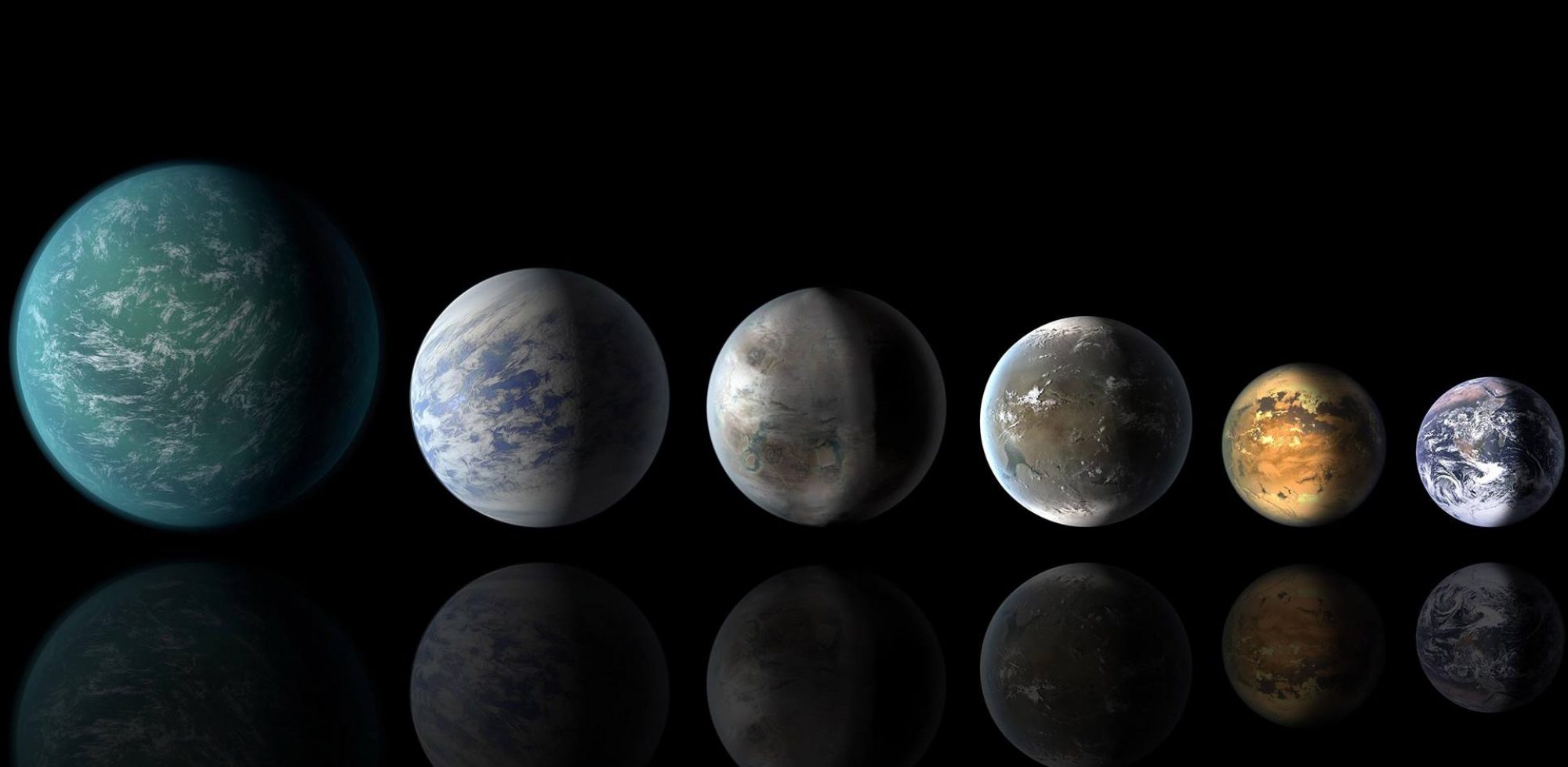
With so many exoplanets already detected, with the pace of discovery continuing to be so fast, and with efforts to find more distant worlds so constant and global, it's easy to become somewhat blase´ about new discoveries. After so many "firsts," and so many different kinds of planets found in very different ways, it certainly …
A Significant Advance: Primitive Earth Life Survives an 18-Month Exposure to Mars-Like Conditions in Space
The question of whether simple life can survive in space is hardly new, but it has lately taken on a new urgency. It is not only a pressing scientific question -- might life from Mars or another body have seeded life on Earth? Might organisms similar to extreme Earth life survive Mars-like conditions? -- but …
Ancient Mars Water. Ever More of It, and Flowing Ever Longer on the Surface
Rather like a swollen river overflowing its banks, the story of water on Mars keeps on rising and spreading in quite unpredictable ways. While the planet is now inarguable parched -- though with lots of polar and subsurface ice and, perhaps, some seasonal surface trickles -- data from the Curiosity rover, the Mars Reconnaissance …
Continue reading "Ancient Mars Water. Ever More of It, and Flowing Ever Longer on the Surface"
A New and Revelatory Window Into Evolution on Earth
Virtually every definition of the word "life" includes the capability to undergo Darwinian evolution as a necessary characteristic. This is true of life on Earth and of thinking about what would constitute life beyond Earth. If it can't change, the thinking goes, then it cannot be truly alive. In addition, evolutionary selection and change occurs …
Continue reading "A New and Revelatory Window Into Evolution on Earth"
Japan’s Hayabusa2 Asteroid Mission Reveals a Remarkable New World
https://www.youtube.com/watch?v=-3hO58HFa1M The Hayabusa2 touchdown movie, taken on February 22, 2019 (JST) when Hayabusa2 first touched down on asteroid Ryugu to collect a sample from the surface. It was captured using the onboard small monitor camera (CAM-H). The video playback speed is five times faster than actual time (JAXA). On March 5 the Japan Aerospace Exploration …
Continue reading "Japan’s Hayabusa2 Asteroid Mission Reveals a Remarkable New World"
How Creatures End Up Miles Below the Surface of Earth, and Maybe Mars Too
When scientists speculate about possible life on Mars, they generally speak of microbial or other simple creatures living deep below the irradiated and desiccated surface. While Mars long ago had a substantial period that was wetter and warmer when it also had a far more protective atmosphere, the surface now is considered to be …
Continue reading "How Creatures End Up Miles Below the Surface of Earth, and Maybe Mars Too"
All About Emergence
If there was a simple meaning of the often-used scientific term “emergence,” then 100-plus scientists wouldn’t have spent four days presenting, debating and not infrequently disagreeing about what it was. But as last month’s organizers of the Earth-Life Science Institute’s “Comparative Emergence” symposium in Tokyo frequently reminded the participants, those debates and disputes are …
The Moon-Forming Impact And Its Gifts
The question of how life-essential elements such as carbon, nitrogen and sulfur came to our planet has been long debated and is a clearly important and slippery scientific subject. Did these volatile elements accrete onto the proto-Earth from the sun's planetary disk as the planet was being formed? Did they arrive substantially later …
Artifacts In Space
All of a sudden, we have spacecraft and objects both coming into our solar system and leaving for interstellar space. This is highly unusual, and very intriguing. The departing spacecraft is Voyager 2, which launched in 1977 and has traveled spaceward some 11 billion miles. It has now officially left the heliosphere, the protective …
 Many Worlds