

The Search for Extraterrestrial Intelligence (SETI) began decades ago as an effort to pick up radio signals from distant civilizations. The effort was centered at the Green Bank Observatory in West Virginia and was by today’s standards quite rudimentary.
A much broader search for distant radio signals remains very much at the core of SETI but the effort has also expanded to be an increasingly rigorous search for “technosignatures.”
These include radio signals, laser beams, the presence of chemical pollutants, unusual planetary heating and even the construction of massive structures around distant planets. All could potentially be signs of intelligent beings living and trying to communicate.
Laser SETI is one of the fastest growing branches of this search of technosignatures and a recent paper that will appear in The Astronomical Journal describes an intriguing technosignature collaboration.
It is a joint effort by The Breakthrough Listen effort, a very large and privately-fund search for evolved extraterrestrial life, and the operators of VERITAS, a ground-based gamma-ray instrument operating at the Fred Lawrence Whipple Observatory (FLWO) in southern Arizona.
The paper does not report any unexpected laser pulses. But as a proof of concept it shows that searching for laser pulses from many light years away is both possible and plausible.
“I would describe our current results as a very promising start,” Gregory Foote, a doctoral student at the University of Delaware and a co-author of the paper, said in an email. “The analysis and observation pipeline is built, so now we can scale up both within VERITAS and with any next generation telescopes which show interest in performing such searches.”
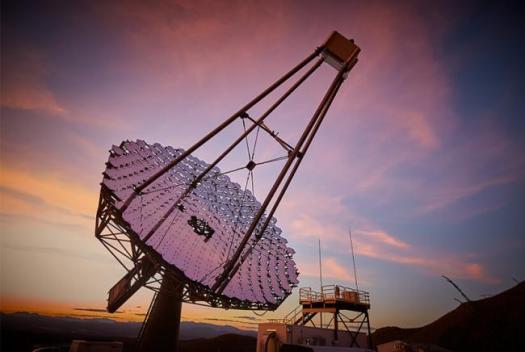
One of the four 12-meter telescopes comprising the VERITAS gamma-ray observatory. VERITAS (Very Energetic Radiation Imaging Telescope Array System) is located at the Fred Lawrence Whipple Observatory in southern Arizona. (CfA/Rick Peterson)
Optical SETI is the name of the overall search for optical technosignatures; signals based on optical light emitters such as lasers. There are two types of laser-based signals that astronomers are currently looking for — a continuous laser beam at a specific wavelength, and nanosecond time-scale pulse lasers. The VERITAS telescope can detect the nanosecond burst of lasers.
“Overall, if one wants to build an interstellar communication system, using pulsed lasers is a power-efficient way to do it,” Foote said. “The technology for both transmitting and receiving doesn’t require any sci-fi infrastructure: it exists today. The pulses we are searching for are simply very intense, but very brief, flashes of blue light.”
“Searching for optical signals is worthwhile because they can potentially be detected over large distances,” said Foote. “We also don’t know what waveband the signal will come from, or whether it will be pulsed or steady. So until a signal is found, it makes sense to search in as many different ways as possible.”

This is the consensus view that came out of a ground-breaking, NASA-sponsored technosignatures conference in 2018. It was expanded in a paper by Pennsylvania State University professor of astronomy and astrophysics Jason Wright et al titled “The Case for Technosignatures: Why They May Be Abundant, Long-lived, Highly Detectable, and Unambiguous.” The paper ran in the Astrophysical Journal Letters, March 2022. Full text.
The targets selected for the 30 hours of VERITAS observations were chosen from the Breakthrough Listen Catalog, which contains the 60 closest stars to Earth, plus a selection of 1,649 stars covering all of the different stellar classes.
“We then ranked these targets based on their closeness and dimness – then selected the top ranking targets for a given observation month: from six to a dozen depending on the circumstances,” Foote explained. “Not all of the targets had known planets, but the ones with planets were chosen for observation more often than not.”
The Whipple array of four telescopes are designed to detect high-energy gamma rays, but they do this indirectly by measuring the flash of blue light that gamma rays produce when they hit the Earth’s atmosphere.
Gamma-ray telescopes can also be used as very large optical telescopes. They are actually some of the largest optical telescopes on the planet, and their cameras are specifically designed to detect very brief flashes of light – exactly what’s needed for optical SETI.
While no laser bursts were detected in the recent campaign, VERITAS did achieve some important support for their methodology. To see if VERITAS could in fact detect nanosecond laser bursts, the telescopes were trained on the NASA/CNES CALIPSO orbiting climate space telescope , which includes a pulsed laser onboard, CALIOP. And the paper reports that VERITAS did indeed make the detection.
“The detection of these pulses with VERITAS, using the analysis techniques developed for our technosignature search, allows a test of our analysis efficiency and serves as an important proof-of-principle,” the paper’s abstract reads.
The paper, which will appear in the Astronomical Journal, is available now on Arxiv.
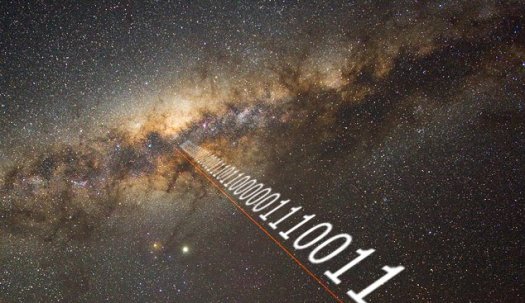
The primary NASA effort to search for life beyond Earth is a decades-long hunt for signs of microbial or possibly more complex life on distant planets. The work is centered around the science of biosignatures — mixes of chemical elements and compounds in an atmosphere or in rocks on Mars that are associated with the presence, or past presence, of life.
The logic of biosignatures is illustrated by the fact that Earth’s atmosphere is about 20 percent oxygen and — if not constantly replenished as a byproduct of life — that level of oxygen would quickly and precipitously decline since oxygen bonds quickly with other elements. So on Earth, oxygen itself is a biosignature.
NASA has historically been wary of including the SETI search for intelligent life into its programs. Some in the agency have questioned the scientific value of the radio-based search, but perhaps more importantly NASA was told by Congress in the early 1990s to keep away from SETI. And it has.
But times change and, following the 2018 NASA technosignatures conference, the agency did award nearly $1 million in grants to a newly formed group called CATS — Categorizing Atmospheric Technosignatures. The goal of CATS is to create a library of possible technosignatures for potential future investigation.
The effort focuses on the composition of atmospheres surrounding distant worlds and what they might tell us not about simple life but rather about the presence and activities of technologically advanced life. The targets of potential future searches might be chemical pollutants, a huge concentrations of devices to collect sunlight and turn it into energy, and chemicals such as chlorofluorocarbons, which might be used to trap heat. In other words, anything detectable that does not exist on its own in nature.
The CATS group is in no way involved with radio signal SETI of the sort championed by the SETI Institute and Breakthrough Listen.
But those groups have also become more involved in searching for technosignatures in general — as seen in the involvement of Breakthrough Listen in optical SETI effort with the VERITAS telescope.
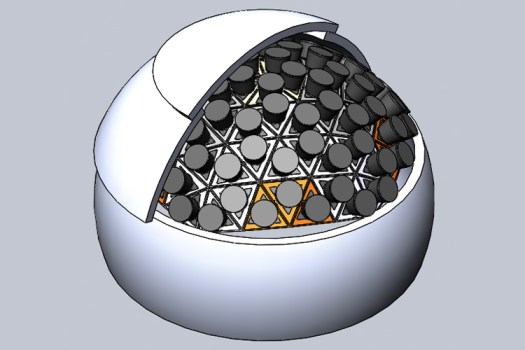
The Breakthrough Listen Initiative, a $100 million program sponsored by tech billionaire Yuri Milner, is using telescopes around the world to search both for unusual radio and optical signals that could be generated by intelligent beings.
It entered an agreement with VERITAS in 2018 because its gamma-ray telescope is and is conducting a program using multiple telescopes around the world to search for technosignatures of extraterrestrial origin from beyond our solar system.
The VERITAS Collaboration joined this program in 2019 because it provides that valuable capability to identify optical pulses of a few nanoseconds duration that are detectable over interstellar distances.
Those super-brief bursts of light can actually leave quite a signature since lasers disperse. You might know this from shining a laser pointer at a wall nearby – the spot of laser light is slightly wider than the lens of the laser. A laser burst traveling over vast interstellar distances could similarly be made to widen so that should it arrive at our solar system, it would have spread the distance from the Sun to Jupiter.
When the VERITAS-Breakthrough Listen collaboration was announced, Breakthrough Listen Principal Investigator Andrew Siemion explained why optical SETI was so attractive.
“Optical communication has already been used by NASA to transmit high definition images to Earth from the moon,” he said. “So there’s reason to believe that an advanced civilization might use a scaled-up version of this technology for interstellar communication.”
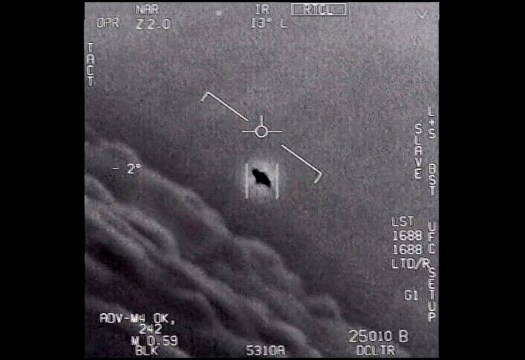
Since before the advent of the space age, the most commonly perceived manifestation of a technosignature was, of course, a UFO. And now that the Department of Defense is releasing decades of data about unexplained space activity that it has collected, there is public and congressional interest for sure.
But there’s not scientific interest to speak of because there’s not really much data. That unexplained objects have been observed in space is hardly surprising, what with the constant arrival of meteorites from within and in 2017 from outside the solar system, with the many, many spy satellites (and balloons!) in orbit, military training missions, and the expansion of commercial spacecraft with orbits that may or may not be known to the pilots who image the “strange” happenings.
So there is no doubt that unexplained objects arrive and fly all the time around Earth. But there is no scientific reason to think that the objects are carrying, or were sent by intelligent beings from afar. They are not included in the realm of technosignatures. They remain in the world of science fiction.
 Many Worlds
One Reply to “”
Comments are closed.