Understanding the make-up and dynamics of atmospheric clouds is crucial to our interpretations of how weather and climate behave on Earth, and so it should come as no surprise that clouds are similarly essential to learning the nature and behavior of exoplanets.
On many exoplanets, thick clouds and related, though different, hazes have been impediments to learning what lies in the atmospheres and on surfaces below. Current technologies simply can’t pierce many of these coverings, and scientists have struggled to find new approaches to the problem.
One class of exoplanets that has been a focus of cloud studies has been, perhaps unexpectedly, hot Jupiters — those massive and initially most surprising gas balls that orbit very close to their suns.
Because of their size and locations, the first exoplanets detected were hot Jupiters. But later work by astronomers, and especially the Kepler Space Telescope, has established that they are not especially common in the cosmos.
Due to their locations close to suns, however, they have been useful targets of study as the exoplanet community moves from largely detecting new objects to trying to characterize them, to understanding their basic features. And clouds are a pathway to that characterization.
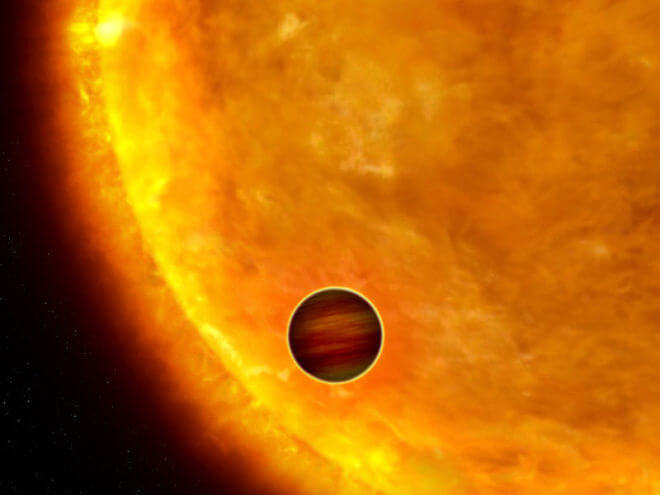
For some time now, scientists have understood that the night sides of the tidally-locked hot Jupiters generally do have clouds, as do the transition zones between day and night. But more recently, some clouds on the super-hot day sides — where temperatures can reach 2400 degrees Fahrenheit –have been identified as well.
Vivien Parmentier, a Sagan Fellow at the University of Arizona, Tucson, as well as planetary scientist Jonathan Fortney of the University of California at Santa Cruz have been studying those day side hot Jupiter clouds to see what they might be made of, and how and why they behave as they do.
“Cloud composition changes with planet temperature,” said Parmentier, who used a 3D General Circulation Model (GCM) to track where clouds form in hot Jupiter atmospheres, and what impact they have on the light emitted and reflected by the planets. “The offsetting light curves tell the tale of cloud composition. It’s super interesting, because cloud composition is very hard to get otherwise.”
The paper by Parmentier, Fortney and others was published in The Astrophysical Journal.
Solid observational evidence of clouds on the days sides of hot Jupiters has been collected for only a short time, and is done by measuring parent starlight being reflected off the atmosphere. Enough information has accumulated by now, Fortney said, to begin to offer theoretical explanations of the measurements being made.
“What this suggests is that the cloud behavior is quite complex — there is no ‘uniform planet-wide cloud,’ for these tidally locked planets,” he said in an email.
“The hot day side may sometimes lack clouds, compared to the cooler night side, where many clouds form. Energy redistribution, via winds, leads to gas that is moving into “sunset” from day to night being cloud-free, but gas going into “sunrise,” moving from night to day is full our cloud material that will evaporate when the gas warms up.
The atmospheres are way too hot for water clouds. Instead, the cloud material detected has been iron and silicate rocks (well-known from brown dwarf atmospheres), and manganese sulfide (which has been suggested for brown dwarf as well.)
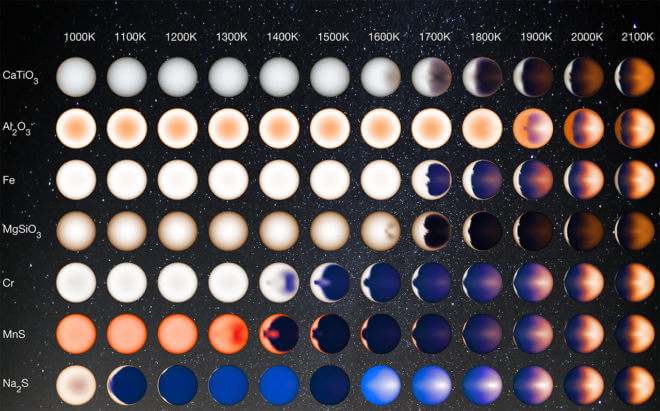
The different elements and compounds in the clouds give hints about the appearance of the planets, and Parmentier used the GCM model to predict what these planets would look like to the human eye.
The differences in color, said Fortney, are a function of the amount of heat coming off the planet and the stellar scattered light coming off of atmospheric gases and clouds. “Not all clouds are the same color, which is fun.”
He also said that “this is the first in what will be a longer study to better understand the transport of cloud material around the planets.
For this first study, we only suggest that clouds will form when the temperature is right, but we didn’t track how the cloud material moves with the flow. That is the next step for a more comprehensive and accurate model.”

The new insights into hot Jupiter clouds via the GCM allowed the team to draw conclusions about wind and temperature differences.
Just before the hotter planets passed behind their stars, a blip in the planet’s optical light curve revealed a “hot spot” on the planet’s eastern side. And on cooler eclipsing planets, a blip was seen just after the planet re-emerged on the other side of the star, this time on the planet’s western side.
The early blip on hotter worlds was interpreted as being powerful winds that were pushing the hottest, cloud-free part of the day side atmosphere to the east. Meanwhile, on cooler worlds, clouds could bunch up and reflect more light on the “colder,” western side of the planet, causing the post-eclipse blip.
“We’re claiming that the west side of the planet’s day side is more cloudy than the east side,” Parmentier said in a JPL release.
While the puzzling pattern has been seen before, this research was the first to study all the hot Jupiters showing this behavior.
This led to another first. By teasing out out how clouds are distributed, which is intimately tied to the planet’s overall temperature, scientists were able to determine the compositions of the clouds — likely formed as exotic vapors condense to form minerals, chemical compounds like aluminum oxide, or even metals, like iron.
The science team found that manganese sulfide clouds probably dominate on “cooler” hot Jupiters, while silicate clouds prevail at higher temperatures. On these planets, the silicates likely “rain out” into the planet’s interior, vanishing from the observable atmosphere.
So while exoplanet clouds can and do mask important information about what lies below in a planet’s atmosphere, scientists are learning ways to use the information that clouds provide to push forward on that process of characterizing the vast menagerie of exoplanets being found.
 Many Worlds