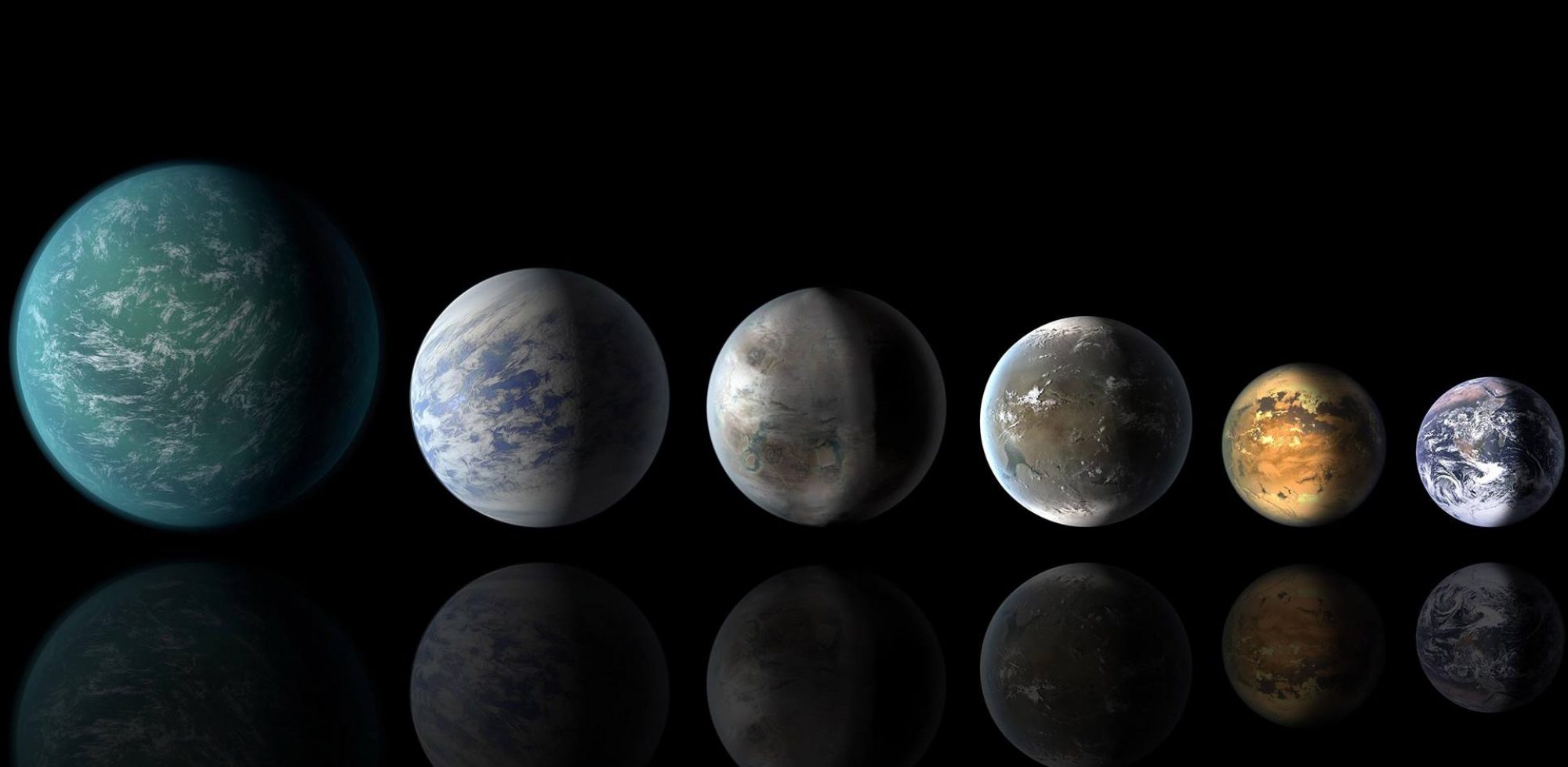
Planets beyond our solar system, we now know, come in all shapes, sizes and consistencies. There are rocky planets, water worlds, gaseous planets, super-Earths, hot Jupiters, tidally locked planets, planets in orbital resonance with each other, and so much more. A group of exoplanet researchers at the University of Cambridge have recently proposed a new …
How Many Habitable Zone Planets Can Orbit a Host Star?
Our solar system has but one planet orbiting in what is commonly known as the habitable zone -- at a distance from the host star where water could be liquid at times rather than always ice or gas. That planet, of course, is Earth. But from a theoretical, dynamical perspective, does this always have to …
Continue reading "How Many Habitable Zone Planets Can Orbit a Host Star?"
Searching for the Edge of Habitability
Topographical map of Venus by NASA's Magellan spacecraft (1990 - 1994). Color indicates height. (NASA/JPL/USGS) How many habitable worlds like our own could exist around other stars? Since the discovery of the first exoplanets, the answer to this question has seemed tantalizingly close. But to estimate the number of Earths, we first need to understand …
Exoplanets With Complex Life May Be Very Rare, Even in Their “Habitable Zones”
For years now, finding planets in the habitable zones of their host stars has been a global astrophysical quest and something of a holy grail. That distance from a star where temperatures could allow H20 to remain liquid some of the time has been deemed the "Goldilocks" zone where life could potentially emerge and …
Continue reading "Exoplanets With Complex Life May Be Very Rare, Even in Their “Habitable Zones”"
What Would Happen If Mars And Venus Swapped Places?
What would happen if you switched the orbits of Mars and Venus? Would our solar system have more habitable worlds? It was a question raised at the “Comparative Climatology of Terrestrial Planets III”; a meeting held in Houston at the end of August. It brought together scientists from disciplines that included astronomers, climate science, …
Continue reading "What Would Happen If Mars And Venus Swapped Places?"
A Solar System Found Crowded With Seven Earth-Sized Exoplanets
Seven planets orbiting one star. All of them roughly the size of Earth. A record three in what is considered the habitable zone, the distance from the host star where liquid water could exist on the surface. The system a mere 40 light-years away. The latest impressive additions to the world of exoplanets orbit the …
Continue reading "A Solar System Found Crowded With Seven Earth-Sized Exoplanets"
Forget the "Habitable Zone," Think the "Biogenic Zone"
It is hardly surprising that in this burgeoning exoplanet era of ours, those hitherto unknown planets get most of the attention when it comes to exo-solar systems. What are the planet masses? Their orbits? The chemical makeup of their atmospheres? Their potential capacity to hold liquid surface water and thereby become "habitable." Less frequently …
Continue reading "Forget the "Habitable Zone," Think the "Biogenic Zone""
Forget the "Habitable Zone," Think the "Biogenic Zone"
It is hardly surprising that in this burgeoning exoplanet era of ours, those hitherto unknown planets get most of the attention when it comes to exo-solar systems. What are the planet masses? Their orbits? The chemical makeup of their atmospheres? Their potential capacity to hold liquid surface water and thereby become "habitable." Less frequently highlighted …
Continue reading "Forget the "Habitable Zone," Think the "Biogenic Zone""
A Flood of Newly Confirmed Exoplanets
In the biggest haul ever of new exoplanets, scientists with NASA's Kepler mission announced the confirmation of 1,284 additional planets outside our solar system -- including nine that are relatively small and within the habitable zones of their host stars. That almost doubles the number of these treasured rocky planets that orbit their stars at …
A Flood of Newly Confirmed Exoplanets
In the biggest haul ever of new exoplanets, scientists with NASA's Kepler mission announced the confirmation of 1,284 additional planets outside our solar system -- including nine that are relatively small and within the habitable zones of their host stars. That almost doubles the number of these treasured rocky planets that orbit their stars at …
 Many Worlds