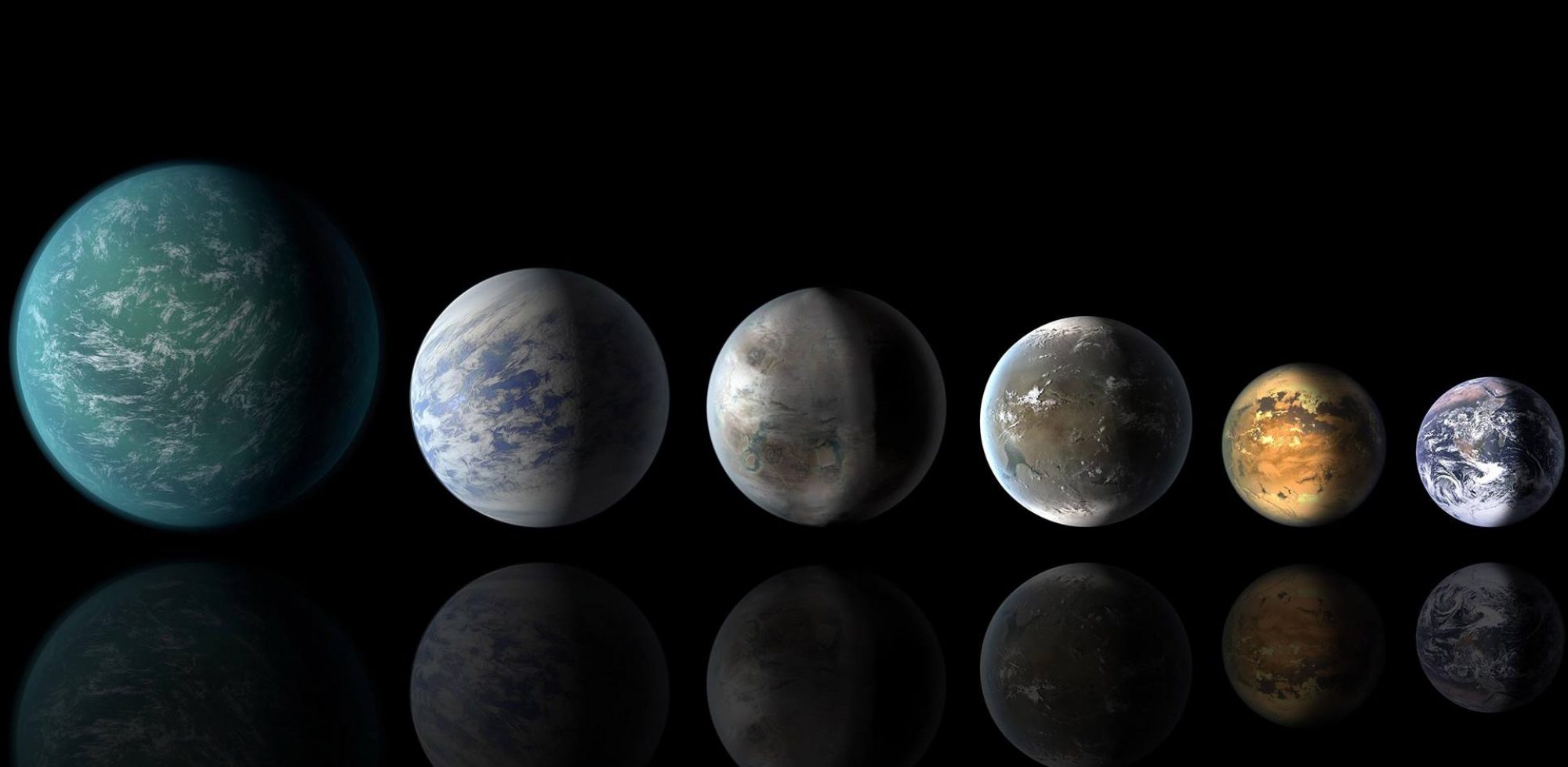
In trying to tease out what a planet is made of, its density is of great importance. Scientists can use that measure of density -- the amount of matter contained in a given volume -- to determine what ratio of a planet is likely is gas, or water, or rocks, or rocks and iron and …
More Weird and Wild Planets
The more we learn about the billions upon billions of planets that orbit beyond our solar system, the more we are surprised by the wild menagerie of objects out there. From the start, many of these untolled planets have been startling, paradigm-breaking, mysterious, hellish, potentially habitable and just plain weird. Despite the confirmed detection of …
Sparkling Gifts From the Hubble Space Telescope, Thirty Years Into Its Mission
For almost 30 years now, the Hubble Space Telescope has transformed how we see the cosmos. In terms of scientific output as well as making visible the splendors of the sky above us, the Hubble has been arguably the most consequential telescope ever to peer into space. To commemorate 30 years of Hubble science and …
Continue reading "Sparkling Gifts From the Hubble Space Telescope, Thirty Years Into Its Mission"
Japan’s Hayabusa2 Mission Returns to Earth
Fireball created by the Hayabusa2 re-entry capsule as it passes through the Earth's atmosphere towards the ground (JAXA). In the mission control room in Japan, all eyes were fixed on one of the large screens that ran along the far wall. The display showed the night sky, with stars twinkling in the blackness. We were …
Continue reading "Japan’s Hayabusa2 Mission Returns to Earth"
The Faint Young Sun Paradox and Mars
When our sun was young, it was significantly less luminous and sent out significantly less warming energy than it does now. Scientists estimate that 4 million years ago, when the sun and our solar system were 500 million years old, the energy that the sun produced and dispersed was about 75 percent of what it …
How Radioactive Elements May Make Planets Suitable or Hostile to Life
When describing exoplanets that are potentially promising candidates for life, scientists often use the terminology of the "habitable zone." This is a description of planets in orbit where temperatures, as predicted by the distance from the host star, are not too cold for liquid water to exist on a planetary surface and also not to …
Continue reading "How Radioactive Elements May Make Planets Suitable or Hostile to Life"
Strong Doubts Arise About the Reported Phosphine Biosignature in the Atmosphere of Venus
What started as a stunning announcement that the chemical phosphine -- a known byproduct of life -- had been found in the clouds of Venus and could signal the presence of some lifeform has now been strongly critiqued by a number of groups of scientists. As a result, there is growing doubt that the finding, …
New Discoveries of Water on the Sunlit Side of the Moon. Might the H2O Be Encased in Glass-like Beads?
The search for water on the moon has produced a discovery of tiny molecule-sized perhaps widespread amounts of H20 in a sunlit lunar crater. The water is not in a liquid or ice or gaseous form, but rather apparently contained (and protected) inside glass beads formed when micrometeorites hit the surface. The detection was made …
OSIRIS-REx Scoops The Surface of the Asteroid Bennu!
Surprising Insights Into the Asteroid Bennu’s Past, as OSIRIS-REx Prepares For a Sample-Collecting “Tag”
Long before there was an Earth, asteroids large and small were orbiting our young sun. Among them was one far enough out from the sun to contain water ice, as well as organic compounds with lots of carbon. In its five billion years or so as an object, the asteroid was hit and broken apart …
 Many Worlds