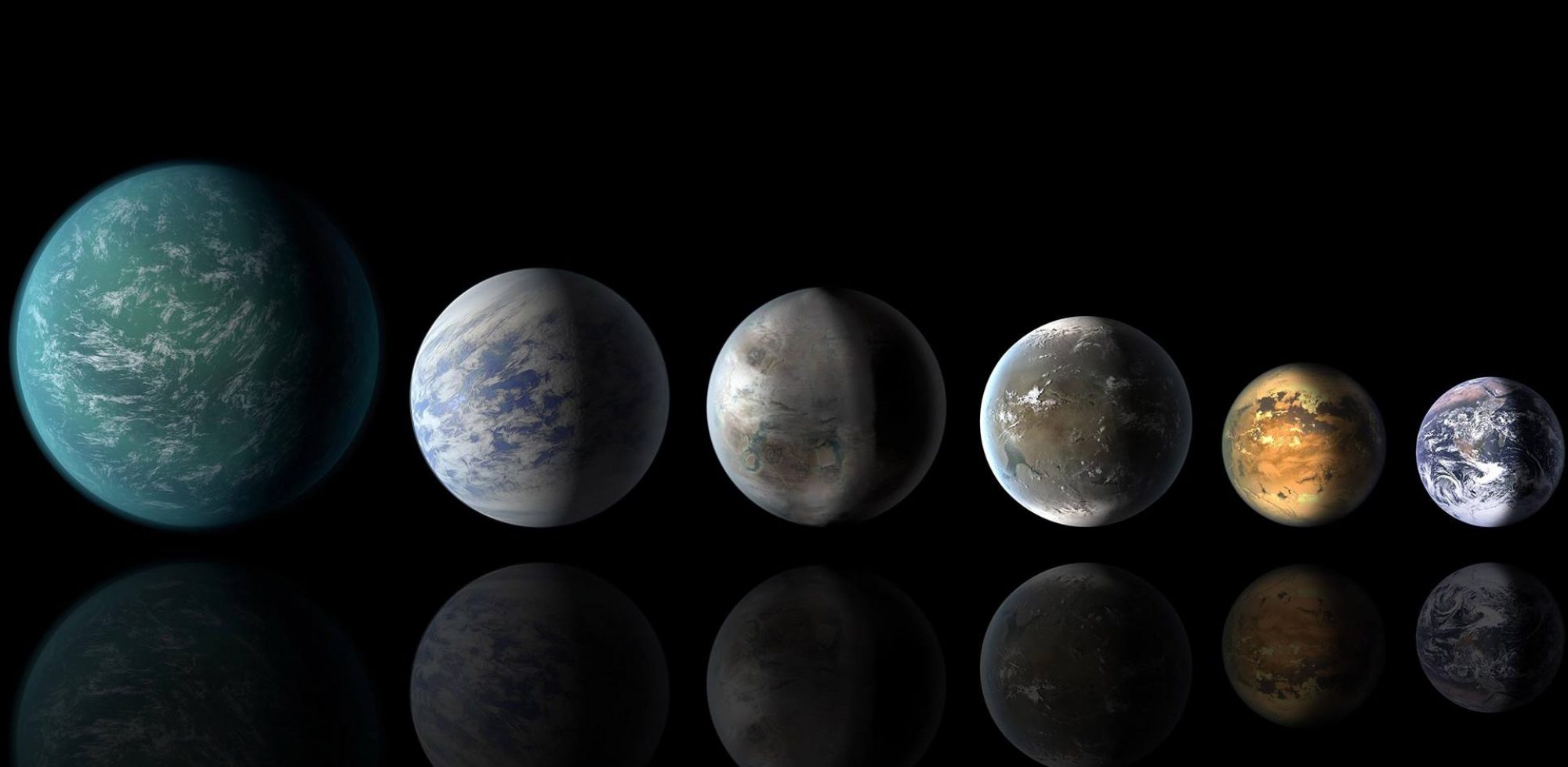
The very first planet detected outside our solar system powerfully made clear that our prior understanding of what planets and solar systems could be like was sorely mistaken. 51 Pegasi was a Jupiter-like massive gas planet, but it was burning hot rather than freezing cold because it orbited close to its host star -- circling …
Probing The Insides of Mars to Learn How Rocky Planets Are Formed
In the known history of our 4.5-billion-year-old solar system, the insides of but one planet have been explored and studied. While there's a lot left to know about the crust, the mantle and the core of the Earth, there is a large and vibrant field dedicated to that learning. Sometime next month, an extensive survey …
Continue reading "Probing The Insides of Mars to Learn How Rocky Planets Are Formed"
Water Worlds, Aquaplanets and Habitability
The more exoplanet scientists learn about the billions and billions of celestial bodies out there, the more the question of unusual planets -- those with characteristics quite different from those in our solar system -- has come into play. Hot Jupiters, super-Earths, planets orbiting much smaller red dwarf stars -- they are all grist …
Continue reading "Water Worlds, Aquaplanets and Habitability"
A New Frontier for Exoplanet Hunting
The first exoplanets were all found using the radial velocity method of measuring the "wobble" of a star -- movement caused by the gravitational pull of an orbiting planet. Radial velocity has been great for detecting large exoplanets relatively close to our solar system, for assessing their mass and for finding out how long …
The Architecture of Solar Systems
Before the discovery of the first exoplanet that orbits a star like ours, 51 Pegasi b, the assumption of solar system scientists was that others planetary systems that might exist were likely to be like ours. Small rocky planets in the inner solar system, big gas giants like Jupiter, Saturn and Neptune beyond and, back …
Exoplanet Science Flying High
Early this spring, the organizers of an exoplanet science gathering at Cambridge University put out the word that they would host a major meeting this summer. Within a week, the 300 allotted slots had been filled by scientists aspiring and veteran, and within a short time the waiting list was up to 150 more. …
Know Thy Star, Know Thy Planet: How Gaia is Helping Nail Down Planet Sizes
Last month, the European Space Agency's Gaia mission released the most accurate catalogue to date of positions and motions for a staggering 1.3 billion stars. Let’s do a few comparisons so we can be suitably amazed. The total number of stars you can see without a telescope is less than 10,000. This includes visible stars …
Continue reading "Know Thy Star, Know Thy Planet: How Gaia is Helping Nail Down Planet Sizes"
First Mapping of Interstellar Clouds in Three Dimensions; a Key Breakthrough for Better Understanding Star Formation
When thinking and talking about "astrobiology," many people are inclined to think of alien creatures that often look rather like us, but with some kind of switcheroo. Life, in this view, means something rather like us that just happens to live on another planet and perhaps uses different techniques to stay alive. But as defined …
To Understand Habitability, We Need to Return to Venus
“You can feel what it’s like on Venus here on Earth,” said Kevin McGouldrick from the Laboratory for Atmospheric and Space Physics at the University of Colorado, Boulder. “Heat a hot plate until it glows red, place your palm on its surface and then run over that hand with a truck.” The surface of Venus …
Continue reading "To Understand Habitability, We Need to Return to Venus"
Can You Overwater a Planet?
Water worlds, especially if they have no land on them, are unlikely to be home to life, or at least life we can detect. Some of the basic atmospheric and mineral cycles that make a planet habitable will be absent. Cool animation of such a world. (NASA) Wherever we find water on Earth, we find …
 Many Worlds