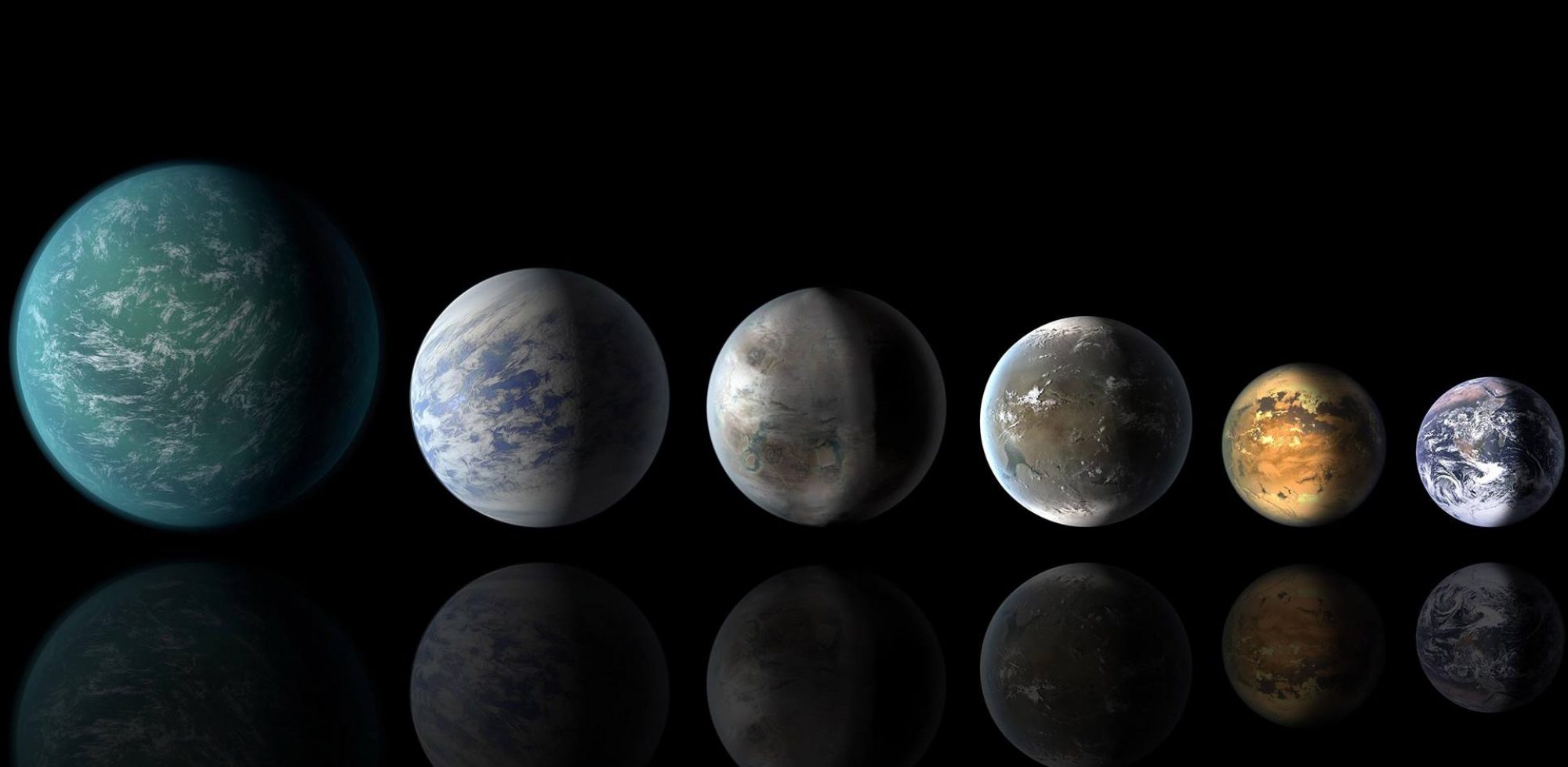
It is often discussed within the community of exoplanet scientists that a danger lies in the description of intriguing exoplanets as "Earth-like." Nothing discovered so far warrants the designation, which is pretty nebulous anyway. Size and the planet's distance from a host star are usually what earn it the title "Earth-like," with its inescapable expectation …
The Case Strengthens For "Planet 9"
The race is on to find the giant planet that several teams of astronomers are convinced orbits far out beyond Pluto, but is nonetheless still part of our solar system. Proving the existence of what has become known as Planet X, or Planet 9, would be a discovery for the textbooks and would inevitably change …
Rocky, Close and Potentially Habitable Planets Around a Dwarf Star
Forty light-years away is no small distance. But an announcement of the discovery of two planets at that separation that have been determined to be rocky and Earth-sized adds a significant new twist to the ever-growing collection of relatively close-by exoplanets that just might be habitable. The two planets in the TRAPPIST-1 system orbit what …
Continue reading "Rocky, Close and Potentially Habitable Planets Around a Dwarf Star"
Rethinking The Snow Line
In every planet-forming disk there's a point where the heat from a host star needed to keep H2O molecules as vapor peters out, and the H2O be becomes a solid crystal. This is the snow line, and it looms large in most theories of planet formation. Most broadly, planets formed inside the snow line will …
Juno, Jupiter and Exo-Jupiters
The last NASA mission to orbit Jupiter, the Galileo, was designed, flown and its data analyzed as if it was circling the only Jupiter in the sky. This is hardly surprising since the spacecraft launched in 1989, before the exoplanet era had arrived. Ironically, Galileo entered its Jupiter orbit in late 1995, just a few …
Big Bangs
What can get the imagination into super-drive more quickly than the crashing of really huge objects? Like when a Mars-sized planet did a head-on into the Earth and, the scientific consensus says, created the moon. Or when a potentially dinosaur-exterminating asteroid heads towards Earth, or when what are now called "near-Earth objects" seems to be …
A Flood of Newly Confirmed Exoplanets
In the biggest haul ever of new exoplanets, scientists with NASA's Kepler mission announced the confirmation of 1,284 additional planets outside our solar system -- including nine that are relatively small and within the habitable zones of their host stars. That almost doubles the number of these treasured rocky planets that orbit their stars at …
Out of the Stovepipes and Into the Galaxy
This “Many Worlds” post is written by Andrew Rushby, a postdoctoral fellow from the United Kingdom who recently began working with NASA's NExSS initiative. The column will hopefully serve to both introduce this new NExSS colleague and to let him share his thoughts about the initiative and what lies ahead. I’m most excited to join …
Continue reading "Out of the Stovepipes and Into the Galaxy"
How Planet 9 Would Make Ours a More Typical Solar System
There’s been a ton of justifiable excitement these days about the possible discovery of a ninth planet in our solar system — an object ten time the mass of Earth and 200 times further from the sun. Especially in the context of the recent demotion of Pluto from a planet to a dwarf planet, …
Continue reading "How Planet 9 Would Make Ours a More Typical Solar System"
The Borderland Where Stars and Planets Meet
Results from two very different papers in recent weeks have brought home one of the more challenging and intriguing aspects of large exoplanet hunting: that some exoplanets the mass of Jupiter and above share characteristics with small, cool stars. And as a result, telling the two apart can sometimes be a challenge. This conclusion does …
Continue reading "The Borderland Where Stars and Planets Meet"
 Many Worlds