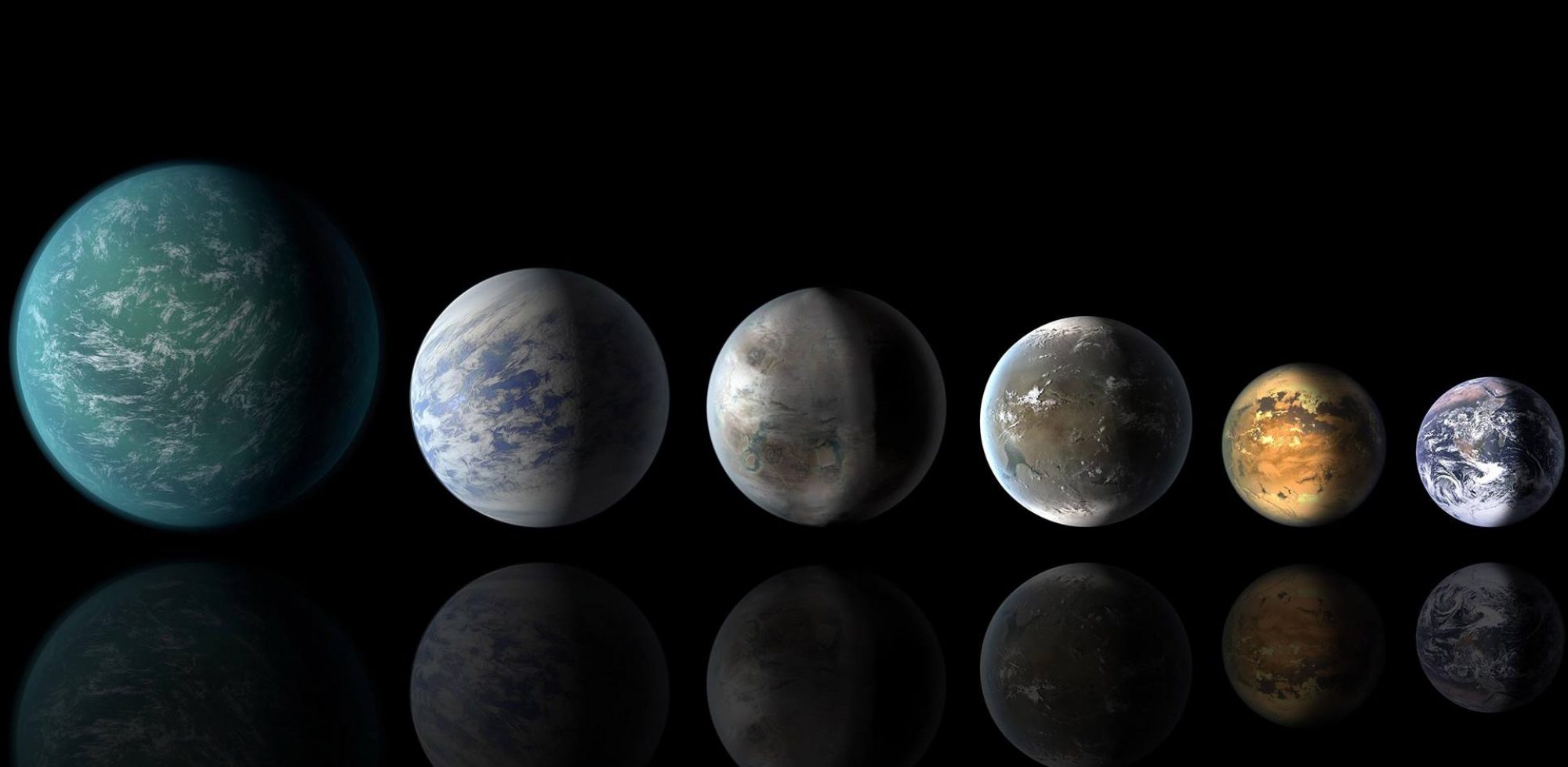
Water worlds, especially if they have no land on them, are unlikely to be home to life, or at least life we can detect. Some of the basic atmospheric and mineral cycles that make a planet habitable will be absent. Cool animation of such a world. (NASA) Wherever we find water on Earth, we find …
Red Dwarf Stars and the Planets Around Them
It's tempting to look for habitable planets around red dwarf stars, which put out far less luminosity and so are less blinding. But is it wise? That question has been near the top of the list for many exoplanet scientists, especially those involved in the search for habitable worlds. Red dwarfs are plentiful (about three-quarters …
Continue reading "Red Dwarf Stars and the Planets Around Them"
Cassini Nearing the End, Still Working Hard
As the Cassini mission embarks on its final dive this Friday into Saturn, it will continue taking photos all the way down (or as far as it remains operations.) We've grown accustomed to seeing remarkable images for the mission and the planet, but clearly the show is not over, and perhaps far from it. …
Continue reading "Cassini Nearing the End, Still Working Hard"
Cassini Inside the Rings of Saturn
The triumphant Cassini mission to Saturn will be coming to an end on September 15, when the spacecraft dives into the planet. Running out of fuel, NASA chose to end the mission that way rather than run the risk of having the vehicle wander and ultimately land on Europa or Enceladus, potentially contaminating two …
Primordial Asteroids, And The Stories They Are Telling
Asteroid, we've long been told, started tiny in our protoplanetary disk and only very gradually became more massive through a process of accretion. They collected dust from the gas cloud that surrounded our new star, and then grew larger through collisions with other growing asteroids. But in recent years, a new school of thought …
Continue reading "Primordial Asteroids, And The Stories They Are Telling"
Phobos and Deimos: Captured Asteroids or Cut From Ancient Mars?
Illustration of Mars with its two moons, Phobos and Deimos. (NASA/JPL-Caltech/Malin Space Science Systems/Texas A&M Univ.) The global success rate for sending missions to land on the moons of Mars has hardly been impressive -- coming in at zero out of three attempts. They were all led by the Russian (or former Soviet) space agencies, …
Continue reading "Phobos and Deimos: Captured Asteroids or Cut From Ancient Mars?"
Getting Real About the Oxygen Biosignature
I remember the first time I heard about the atmospheres of distant exoplanets and how could and would let us know whether life was present below. The key was oxygen or its light-modified form, ozone. Because both oxygen and ozone molecules bond so quickly with other molecules -- think rust or iron oxide on …
Continue reading "Getting Real About the Oxygen Biosignature"
Elegant Image of Icy Disk Around The Young Fomalhaut System
An international team of astronomers using the Atacama Large Millimeter/submillimeter Array (ALMA) has made the first complete millimeter-wavelength image of the ring of dusty debris surrounding the young star Fomalhaut. This well-defined band of rubble and gas is likely the result of comets smashing together near the outer edges of a planetary system 25 light-years from …
Continue reading "Elegant Image of Icy Disk Around The Young Fomalhaut System"
Where Should We Look for Ancient Biosignatures on Mars in 2020?
One of the great successes of the Curiosity mission to Mars is that the rover landed at what turned out to be a goldmine of a location. The mission has once and for all determined that the planet was habitable at least during its early days, that it contains the organic building blocks of life, …
Continue reading "Where Should We Look for Ancient Biosignatures on Mars in 2020?"
NASA Panel Supports Life-Detecting Lander for Europa; Updated
As I prepare for the Astrobiology Science Conference (Abscicon) next week in Arizona, I'm struck by how many speakers will be discussing Europa missions, Europa science, ocean worlds and habitability under ice. NASA's Europa Clipper mission to orbit that moon, scheduled for launch to the Jupiter system in the mid 2020s, explains part of the …
Continue reading "NASA Panel Supports Life-Detecting Lander for Europa; Updated"
 Many Worlds