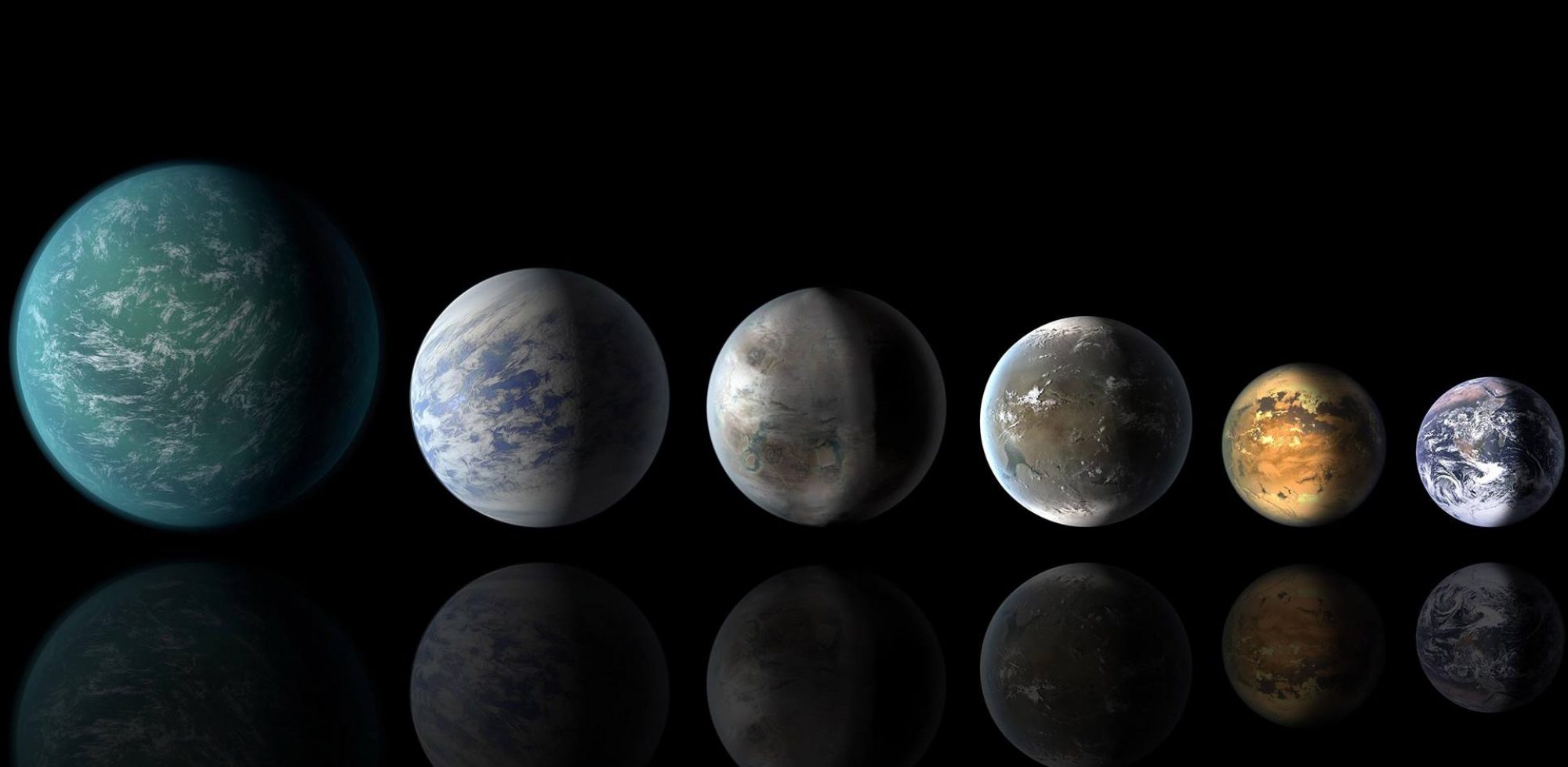
When especially interesting new planets are discovered in the cosmos, scientists around the world begin the process of identifying their characteristics -- their orbit, their mass and density, their composition, their thermal properties and much more. It's all part of a drive that seems to be innate in humans to learn about the workings of …
On The Frontier Of The Hunt For Signs Of Life On Early Earth And Ancient Mars
Seldom does one rock outcrop get so many visitors in a day, especially when that outcrop is located in rugged, frigid terrain abutting the Greenland Ice Sheet and can be reached only by helicopter. But this has been a specimen of great importance and notoriety since it appeared from beneath the snow pack some eight …
Continue reading "On The Frontier Of The Hunt For Signs Of Life On Early Earth And Ancient Mars"
If Bacteria Could Talk
Did you know that many bacteria -- some of the oldest lifeforms on Earth -- can talk? Really. And not only between the same kind of single-cell bacteria, but back and forth with members of other species, too. Okay, they don't talk in words or with sounds at all. But they definitely communicate in …
How Creatures End Up Miles Below the Surface of Earth, and Maybe Mars Too
When scientists speculate about possible life on Mars, they generally speak of microbial or other simple creatures living deep below the irradiated and desiccated surface. While Mars long ago had a substantial period that was wetter and warmer when it also had a far more protective atmosphere, the surface now is considered to be …
Continue reading "How Creatures End Up Miles Below the Surface of Earth, and Maybe Mars Too"
All About Emergence
If there was a simple meaning of the often-used scientific term “emergence,” then 100-plus scientists wouldn’t have spent four days presenting, debating and not infrequently disagreeing about what it was. But as last month’s organizers of the Earth-Life Science Institute’s “Comparative Emergence” symposium in Tokyo frequently reminded the participants, those debates and disputes are …
The Northern Lights (Part Two)
In my recent column about The Northern Lights, the Magnetic Field and Life, I explored the science and the beauty of our planet's aurora borealis, one of the great natural phenomenon we are most fortunate to see in the far North (and much less frequently in the not-quite-so-far North.) I learned the hard way that …
The Northern Lights, the Magnetic Field and Life
May I please invite you to join me in the presence of one of the great natural phenomena and spectacles of our world. Not only is it enthralling to witness and scientifically crucial, but it’s quite emotionally moving as well. Why? Because what’s before me is a physical manifestation of one of the primary, but …
Continue reading "The Northern Lights, the Magnetic Field and Life"
2.5 Billion Years of Earth History in 100 Square Feet
Along the edge of an inlet on a tiny Japanese island can be found– side by side – striking examples of conditions on Earth some 2.4 billion years ago, then 1.4 billion years ago and then the Philippine Sea of today. First is a small channel with iron red, steaming and largely oxygen-free water – …
Continue reading "2.5 Billion Years of Earth History in 100 Square Feet"
Messy Chemistry: A New Way to Approach the Origins of Life
More than a half century ago, Stanley Miller and Harold Urey famously put water and gases believed to make up the atmosphere of early Earth into a flask with water, sparked the mix with an electric charge, and produced amino acids and other chemical building blocks of life. The experiment was hailed as a ground-breaking …
Continue reading "Messy Chemistry: A New Way to Approach the Origins of Life"
Nobel Laureate Jack Szostak: Exoplanets Gave The Origin of Life Field a Huge Boost
Sometimes tectonic shifts in scientific disciplines occur because of discoveries and advances in the field. But sometimes they occur for reasons entirely outside the field itself. Such appears to be case with origins-of-life studies. Nobel laureate Jack Szostak was recently in Tokyo to participate in a workshop at the Earth-Life Science Institute (ELSI) at the …
 Many Worlds