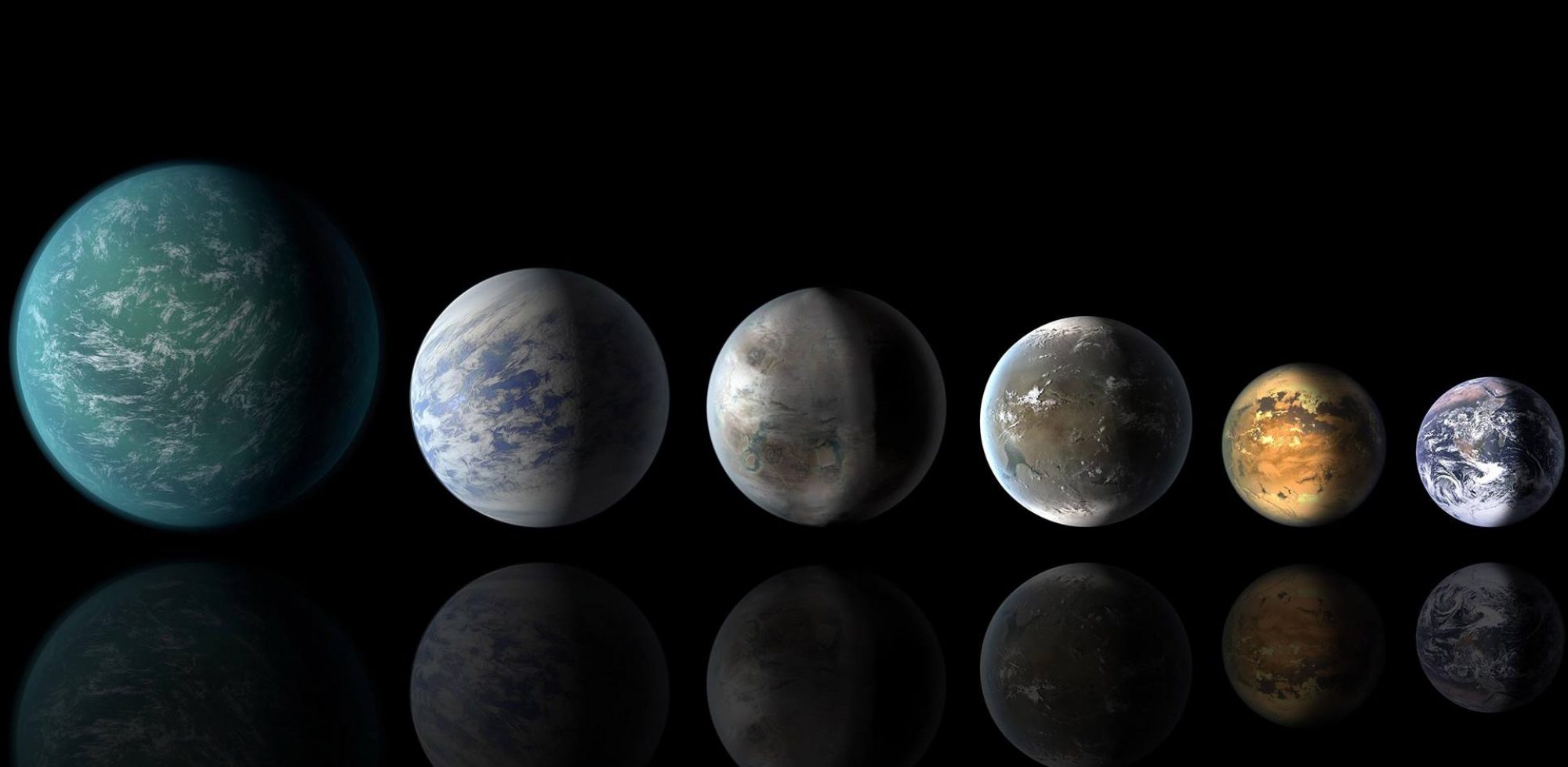
What observations, or groups of observations, would tell exoplanet scientists that life might be present on a particular distant planet? The most often discussed biosignature is oxygen, the product of life on Earth. But while oxygen remains central to the search for biosignatures afar, there are some serious problems with relying on that molecule. It …
Putting Together a Community Strategy To Search for Extraterrestrial Life
I regret that the formatting of this column was askew earlier; I hope it didn't make reading too difficult. But now those problems are fixed. Behind the front page space science discoveries that tell us about the intricacies and wonders of our world are generally years of technical and intellectual development, years of planning and …
Continue reading "Putting Together a Community Strategy To Search for Extraterrestrial Life"
A New Way to Find Signals of Habitable Exoplanets?
The search for biosignatures in the atmospheres of distant exoplanets is extremely difficult and time-consuming work. The telescopes that can potentially take the measurements required are few and more will come only slowly. And for the current and next generation of observatories, staring at a single exoplanet long enough to get a measurement of the …
Continue reading "A New Way to Find Signals of Habitable Exoplanets?"
Red Dwarf Stars and the Planets Around Them
It's tempting to look for habitable planets around red dwarf stars, which put out far less luminosity and so are less blinding. But is it wise? That question has been near the top of the list for many exoplanet scientists, especially those involved in the search for habitable worlds. Red dwarfs are plentiful (about three-quarters …
Continue reading "Red Dwarf Stars and the Planets Around Them"
The Very Influential Natalie Batalha
I'd like to make a slight detour and talk not about the science of exoplanets and astrobiology, but rather a particular exoplanet scientist who I've had the pleasure to work with. The scientist is Natalie Batalha, who has been lead scientist for NASA's landmark Kepler Space Telescope mission since soon after it launched in 2009, …
A Four Planet System in Orbit, Directly Imaged and Remarkable
Now on Facebook: http://facebook.com/nexssmanyworlds/ The era of directly imaging exoplanets has only just begun, but the science and viewing pleasures to come are appealingly apparent. This evocative movie of four planets more massive than Jupiter orbiting the young star HR 8799 is a composite of sorts, including images taken over seven years at the W.M. …
Continue reading "A Four Planet System in Orbit, Directly Imaged and Remarkable"
Proxima b Is Surely Not "Earth-like." But It’s A Research Magnet And Just May Be Habitable.
It is often discussed within the community of exoplanet scientists that a danger lies in the description of intriguing exoplanets as "Earth-like." Nothing discovered so far warrants the designation, which is pretty nebulous anyway. Size and the planet's distance from a host star are usually what earn it the title "Earth-like," with its inescapable expectation …
Coming to Terms With Biosignatures
The search for life beyond our solar system has focused largely on the detection of an ever-increasing number of exoplanets, determinations of whether the planets are in a habitable zone, and what the atmospheres of those planets might look like. It is a sign of how far the field has progressed that scientists are now …
Out of the Stovepipes and Into the Galaxy
This “Many Worlds” post is written by Andrew Rushby, a postdoctoral fellow from the United Kingdom who recently began working with NASA's NExSS initiative. The column will hopefully serve to both introduce this new NExSS colleague and to let him share his thoughts about the initiative and what lies ahead. I’m most excited to join …
Continue reading "Out of the Stovepipes and Into the Galaxy"
Breaking Down Exoplanet Stovepipes
That fields of science can benefit greatly from cross-fertilization with other disciplines is hardly a new idea. We have, after all, long-standing formal disciplines such as biogeochemistry -- a mash-up of many fields that has the potential to tell us more about the natural environment than any single approach. Astrobiology in another field that inherently …
 Many Worlds