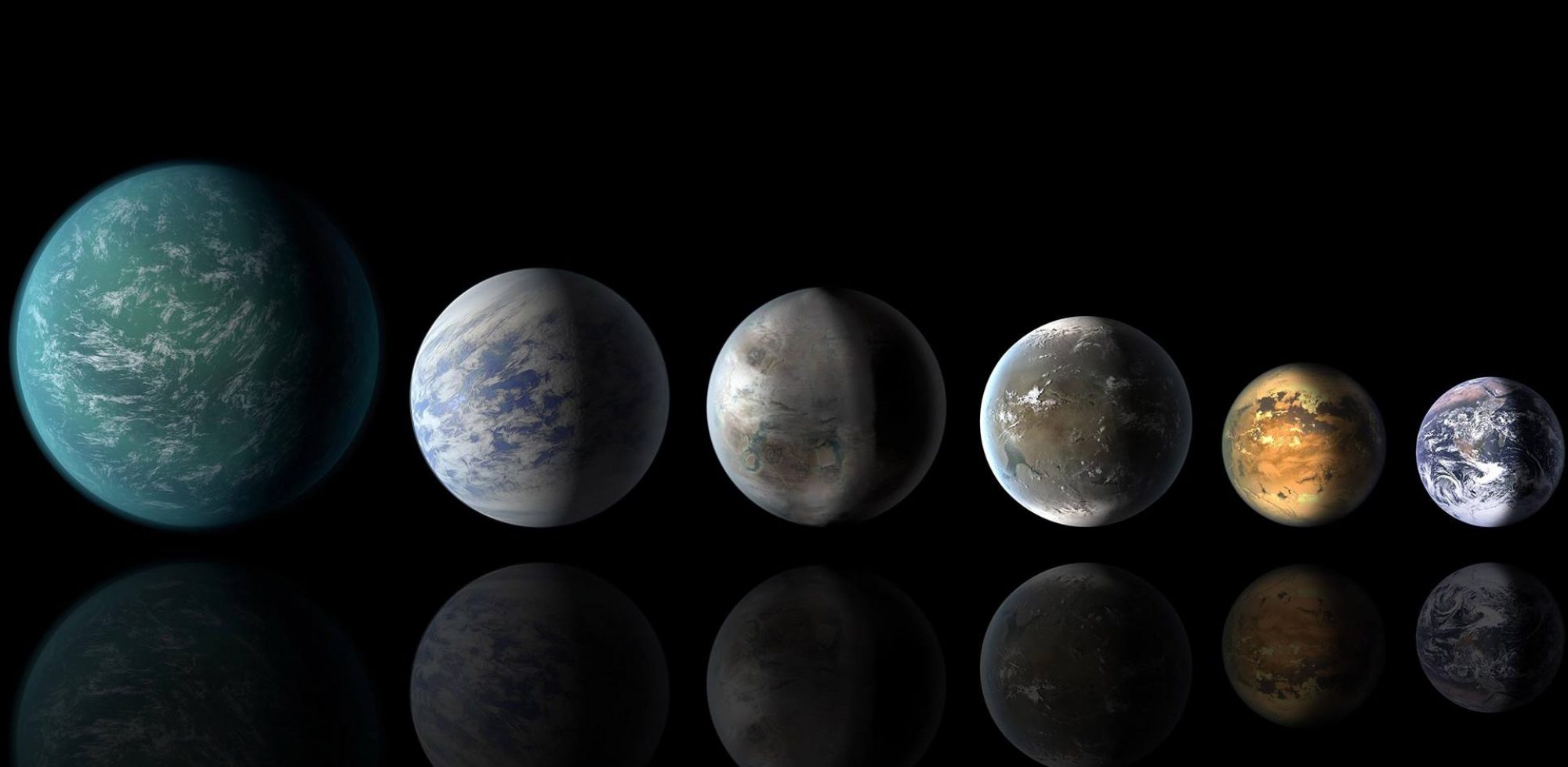
Assuming for a moment that life exists on some exoplanets, how might researchers detect it? This is hardly a new question. More than ten years ago, competing teams of exo-scientists and engineers came up with proposals for a NASA flagship space observatory capable of identifying possible biosignatures on distant planets. No consensus was reached, however, …
The IAU on ExoNames
The IAU, in the person of Executive Committee member and former General Secretary Thierry Montmerle, wrote the following response to an earlier column, "(Mostly) Thumbs Down on ExoNames." The response to the article was first posted as a comment on the Many Worlds site, but to ensure that it is seen by readers I …
How Will We Know What Exoplanets Look Like, and When?
An earlier version of this article was accidently published last week before it was completed. This is the finished version, with information from this week's AAS annual conference. Let's face it: the field of exoplanets has a significant deficit when it comes to producing drop-dead beautiful pictures. We all know why. Exoplanets are just too …
Continue reading "How Will We Know What Exoplanets Look Like, and When?"
(Mostly) Thumbs Down on ExoNames
The name 51 Pegasi B, the first planet identified outside of our solar system, has been eclipsed. Now it is Dimidium. The (at least) five planet system orbiting the star formerly known as 55 Cancri now circles the star Copernicus. And those planets 55 Cancri B, C, D, E, and F are Galileo, Brahe, Lippershey, …
The Borderland Where Stars and Planets Meet
Results from two very different papers in recent weeks have brought home one of the more challenging and intriguing aspects of large exoplanet hunting: that some exoplanets the mass of Jupiter and above share characteristics with small, cool stars. And as a result, telling the two apart can sometimes be a challenge. This conclusion does …
Continue reading "The Borderland Where Stars and Planets Meet"
Faint Worlds On the Far Horizon
For thinking about the enormity of the canvas of potential suns and exoplanets, I find images like this and what they tell us to be an awkward combination of fascinating and daunting. This is an image that, using the combined capabilities of NASA's Hubble and Spitzer space telescopes, shows what is being described as the …
Many Worlds, Subterranean Edition
One of the richest lines of research for those thinking about life beyond Earth has been the world of microscopic creatures that live in especially extreme and hostile environments here. The realm of extremophiles has exploded in roughly the period that exoplanet discoveries have exploded, and both serve to significantly change our view of what's …
On Super-Earths, Sub-Neptunes and Some Lessons They Teach
Part 2 of 2 With such a large proportion of identified exoplanets in the super-Earth to sub-Neptune class, an inescapable question arises: how conducive might they be to the origin and maintenance of life? So little is actually know about the characteristics of these planets that are larger than Earth but smaller than Neptune …
Continue reading "On Super-Earths, Sub-Neptunes and Some Lessons They Teach"
On Super-Earths, Sub-Neptunes and Some Lessons They Teach
Part 1 of 2 When the first exoplanet was identified and confirmed 20 years ago, there was enormous excitement, a sense of historic breakthrough and, with almost parallel intensity, sheer bewilderment. The planet, 51 Pegasi B, was larger than Jupiter yet orbited its parent star in 4 days. In other words, it was much closer …
Continue reading "On Super-Earths, Sub-Neptunes and Some Lessons They Teach"
Counting Our Countless Worlds
Imagine counting all the people who have ever lived on Earth, well over 100 billion of them. Then imagine counting all the planets now orbiting stars in our Milky Way galaxy , and in particular the ones that are roughly speaking Earth-sized. Not so big that the planet turns into a gas giant, and not so …
 Many Worlds