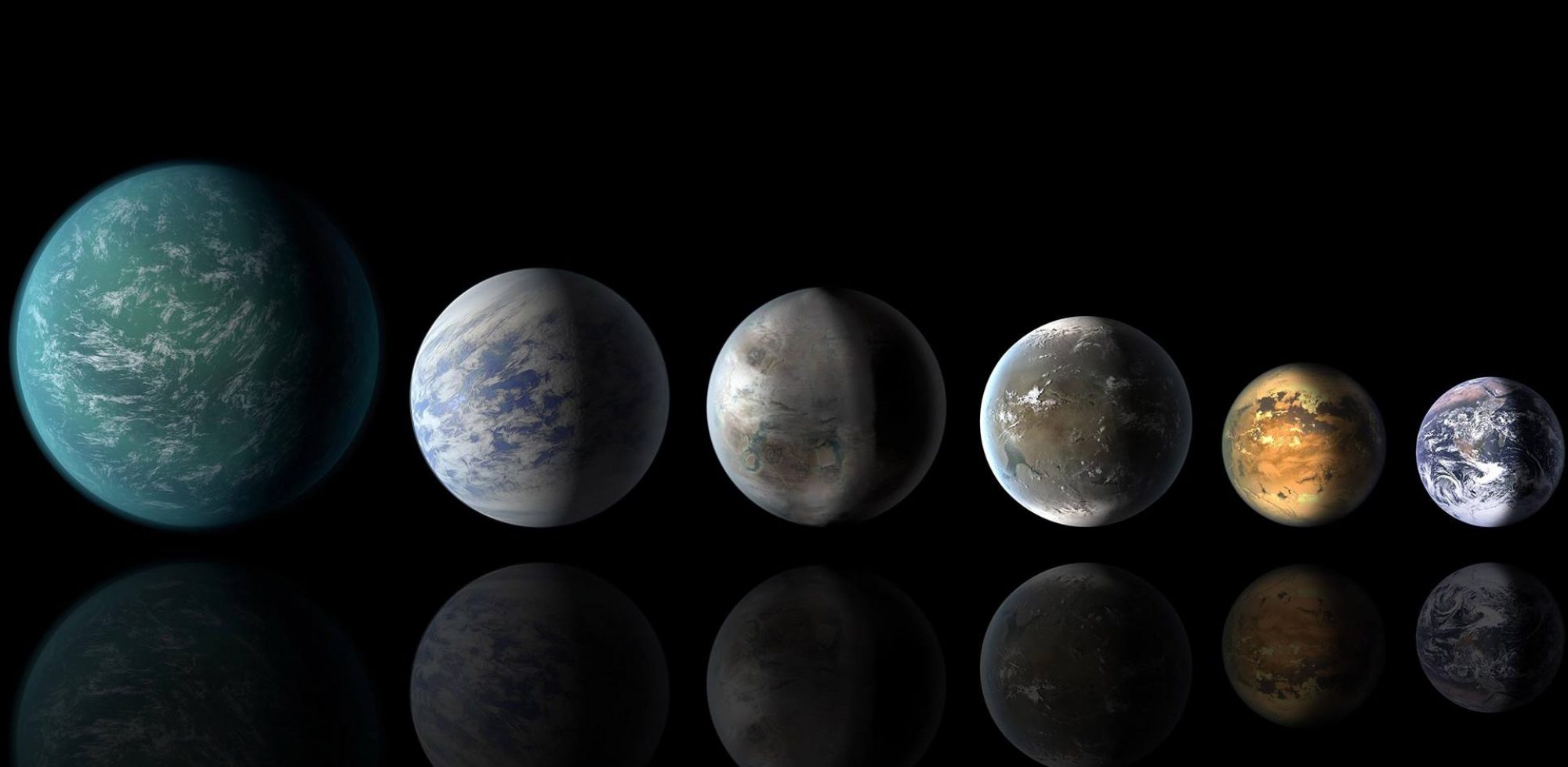
Now that we know that there are billions and billions of planets beyond our solar system, and we even know where thousands of confirmed and candidate planets are located, where should we be looking for those planets that could in theory support extraterrestrial life, and might just possibly support it now? The first order …
Hunting for Exoplanets Via TESS
Seven years ago this month the Kepler spacecraft launched into space – the first NASA mission dedicated to searching for planets around distant stars. The goal was to conduct a census of these exoplanets, to learn whether planets are common or rare. And in particular, to understand whether planets like Earth are common or …
The Habitable Zone Gets Poked, Tweaked and Stretched to the Limits
For more than 20 years now -- even before the first detection of an extra-solar planet -- scientists have posited, defined and then debated the existence and nature of a habitable zone. It's without a doubt a central scientific concept, and the idea has caught on with the public (and the media) too. The discovery …
Continue reading "The Habitable Zone Gets Poked, Tweaked and Stretched to the Limits"
The Search for Exoplanet Life Goes Broad and Deep
I had the good fortune several years ago to spend many hours in meetings of the science teams for the Curiosity rover, listening in on discussions about what new results beamed back from Mars might mean about the planet's formation, it's early history, how it gained and lost an atmosphere, whether it was a place …
Continue reading "The Search for Exoplanet Life Goes Broad and Deep"
The Pale Red Dot Campaign
Astronomers have been trying for decades to find a planet orbiting Proxima Centauri, the star closest to our sun and so a natural and tempting target. Claims of an exoplanet discovery have been made before, but so far none have held up. Now, in a novel and very public way, a group of European astronomers …
Movement in The Search For ExoLife
Assuming for a moment that life exists on some exoplanets, how might researchers detect it? This is hardly a new question. More than ten years ago, competing teams of exo-scientists and engineers came up with proposals for a NASA flagship space observatory capable of identifying possible biosignatures on distant planets. No consensus was reached, however, …
Enceladus and Water Worlds
As if the prospect of billions of potentially habitable exoplanets wasn't enough to get people excited, what about all those watery exo-moons too? The question arises as the Cassini mission makes its final pass near the now famous geysers at the south pole of the moon Enceladus. The plumes are currently in darkness and …
Faint Worlds On the Far Horizon
For thinking about the enormity of the canvas of potential suns and exoplanets, I find images like this and what they tell us to be an awkward combination of fascinating and daunting. This is an image that, using the combined capabilities of NASA's Hubble and Spitzer space telescopes, shows what is being described as the …
Exoplanet Earth
Some two billion years ago, all of Earth may well have been covered in snow and ice. Oceans, continents, everything, and for many millions of years. Observed from afar, the planet would be pretty low on the list of planets that might conceivably support life. But we know that it did. Five hundred to seven …
Many Worlds, Subterranean Edition
One of the richest lines of research for those thinking about life beyond Earth has been the world of microscopic creatures that live in especially extreme and hostile environments here. The realm of extremophiles has exploded in roughly the period that exoplanet discoveries have exploded, and both serve to significantly change our view of what's …
 Many Worlds