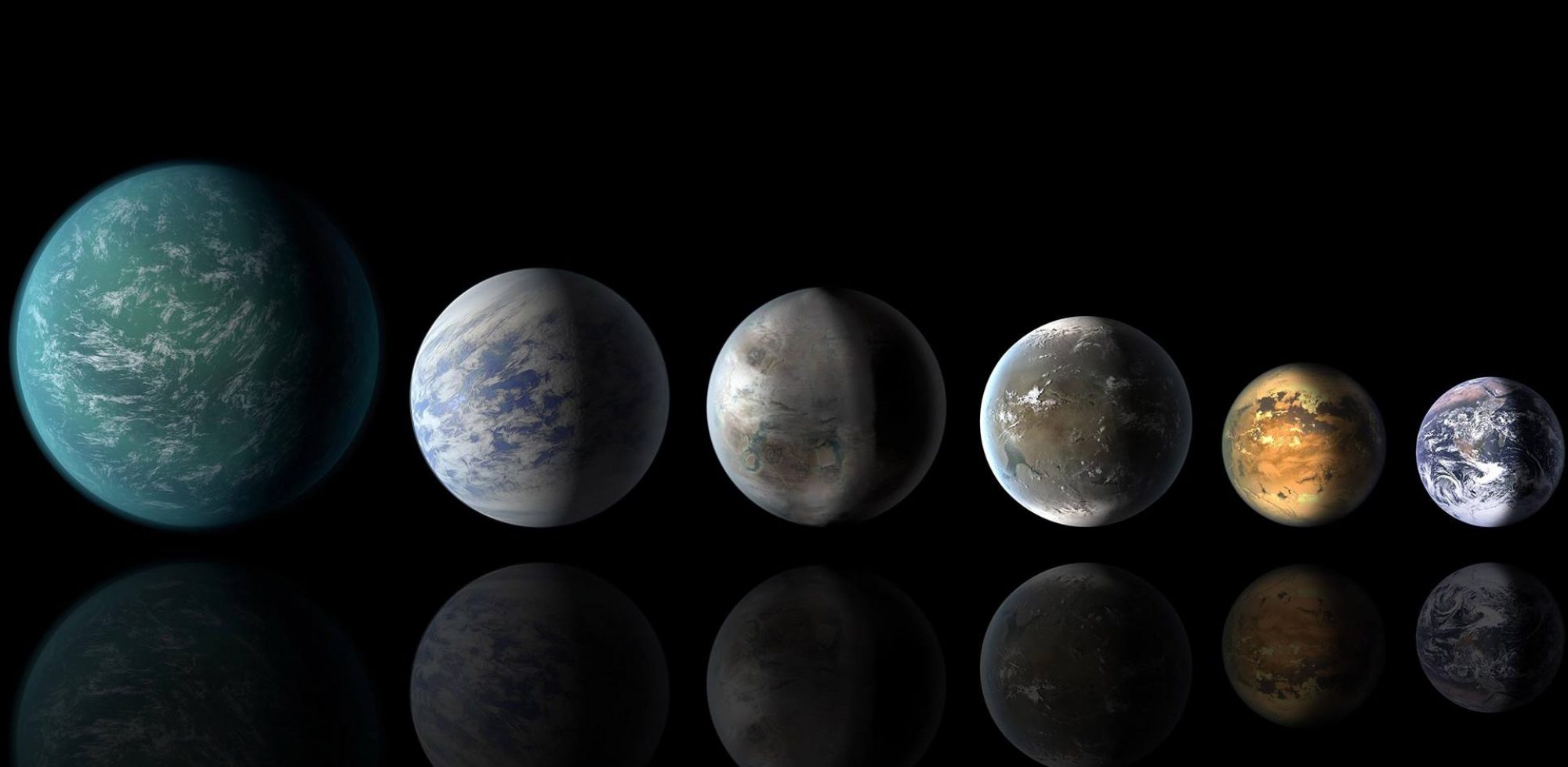
Water worlds, especially if they have no land on them, are unlikely to be home to life, or at least life we can detect. Some of the basic atmospheric and mineral cycles that make a planet habitable will be absent. Cool animation of such a world. (NASA) Wherever we find water on Earth, we find …
2.5 Billion Years of Earth History in 100 Square Feet
Along the edge of an inlet on a tiny Japanese island can be found– side by side – striking examples of conditions on Earth some 2.4 billion years ago, then 1.4 billion years ago and then the Philippine Sea of today. First is a small channel with iron red, steaming and largely oxygen-free water – …
Continue reading "2.5 Billion Years of Earth History in 100 Square Feet"
Could High-Energy Radiation Have Played an Important Role in Getting Earth Ready For Life?
A version of this article first appeared in Astrobiology Magazine, http://www.astrobio.net. Life on early Earth seems to have begun with a paradox: while life needs water as a solvent, the essential chemical backbones of early life-forming molecules fall apart in water. Our universal solvent, it turns out, can be extremely corrosive. Some have pointed to …
Messy Chemistry: A New Way to Approach the Origins of Life
More than a half century ago, Stanley Miller and Harold Urey famously put water and gases believed to make up the atmosphere of early Earth into a flask with water, sparked the mix with an electric charge, and produced amino acids and other chemical building blocks of life. The experiment was hailed as a ground-breaking …
Continue reading "Messy Chemistry: A New Way to Approach the Origins of Life"
Certain Big, Charged Molecules Are Universal to Life on Earth. Can They Help Detect It In The Far Solar System?
This article of mine, slightly tweaked for Many Worlds, first appeared today (July 6) in Astrobiology Magazine, http://www.astrobio.net As NASA inches closer to launching new missions to the Solar System’s outer moons in search of life, scientists are renewing their focus on developing a set of universal characteristics of life that can be measured. …
In Search of Panspermia (and Life on Icy Moons)
Sometimes personal affairs intervene for all of us, and they have now for your Many Worlds writer and his elderly father. But rather than remain off the radar screen, I wanted to repost this column which has a new import. It turns out that versions of the instrument described below -- a miniature gene …
Continue reading "In Search of Panspermia (and Life on Icy Moons)"
What Astrochemistry is Telling Us
Sometimes lost in the discussion of exoplanets and habitability is where the potential building blocks of life might come from and how they got there. Yes, hydrogen and water and methane and carbon and nitrogen have been found in abundance around the cosmos, but how about the larger and more esoteric compounds needed for life …
Nobel Laureate Jack Szostak: Exoplanets Gave The Origin of Life Field a Huge Boost
Sometimes tectonic shifts in scientific disciplines occur because of discoveries and advances in the field. But sometimes they occur for reasons entirely outside the field itself. Such appears to be case with origins-of-life studies. Nobel laureate Jack Szostak was recently in Tokyo to participate in a workshop at the Earth-Life Science Institute (ELSI) at the …
Getting Real About the Oxygen Biosignature
I remember the first time I heard about the atmospheres of distant exoplanets and how could and would let us know whether life was present below. The key was oxygen or its light-modified form, ozone. Because both oxygen and ozone molecules bond so quickly with other molecules -- think rust or iron oxide on …
Continue reading "Getting Real About the Oxygen Biosignature"
Planetary Protection is a "Wicked" Problem
The only time that a formally designated NASA "life detection" mission was flown to another planet or moon was when the two Viking landers headed to Mars forty years ago. The odds of finding some kind of Martian life seemed so promising at the time that there was little dispute about how much energy, money …
Continue reading "Planetary Protection is a "Wicked" Problem"
 Many Worlds