The name 51 Pegasi B, the first planet identified outside of our solar system, has been eclipsed. Now it is Dimidium. The (at least) five planet system orbiting the star formerly known as 55 Cancri now circles the star Copernicus. And those planets 55 Cancri B, C, D, E, and F are Galileo, Brahe, Lippershey, …
Enceladus and Water Worlds
As if the prospect of billions of potentially habitable exoplanets wasn't enough to get people excited, what about all those watery exo-moons too? The question arises as the Cassini mission makes its final pass near the now famous geysers at the south pole of the moon Enceladus ,scheduled for Saturday. The plumes are currently in …
The Borderland Where Stars and Planets Meet
Results from two very different papers in recent weeks have brought home one of the more challenging and intriguing aspects of large exoplanet hunting: that some exoplanets the mass of Jupiter and above share characteristics with small, cool stars. And as a result, telling the two apart can sometimes be a challenge. This conclusion does …
Continue reading "The Borderland Where Stars and Planets Meet"
Faint Worlds On the Far Horizon
For thinking about the enormity of the canvas of potential suns and exoplanets, I find images like this and what they tell us to be an awkward combination of fascinating and daunting. This is an image that, using the combined capabilities of NASA's Hubble and Spitzer space telescopes, shows what is being described as the …
Exoplanet Earth
Some two billion years ago, all of Earth may well have been covered in snow and ice. Oceans, continents, everything, and for many millions of years. Observed from afar, the planet would be pretty low on the list of planets that might conceivably support life. But we know that it did. Five hundred to seven …
Many Worlds, Subterranean Edition
One of the richest lines of research for those thinking about life beyond Earth has been the world of microscopic creatures that live in especially extreme and hostile environments here. The realm of extremophiles has exploded in roughly the period that exoplanet discoveries have exploded, and both serve to significantly change our view of what's …
Retro Exo and Its Originators
Exoplanets are mysterious, they're complicated, they're important, they're awe-inspiring. And, to a team of artists at the Jet Propulsion Lab, they're also totally fun. They're a topic for endless artistic creation because they're that remarkable combination of brand new and, surprisingly, comfortably familiar. Exoplanets may be weird and wild but they're also potentially home …
France and Exoplanets
For reasons all too regrettable, it seems appropriate today to highlight the extensive work being done in France and by French scientists to move forward the science of exoplanets. The American public tends to view space observatories and exoplanet research as largely the domain of NASA and our nation. While we are leaders for sure, …
On Super-Earths, Sub-Neptunes and Some Lessons They Teach
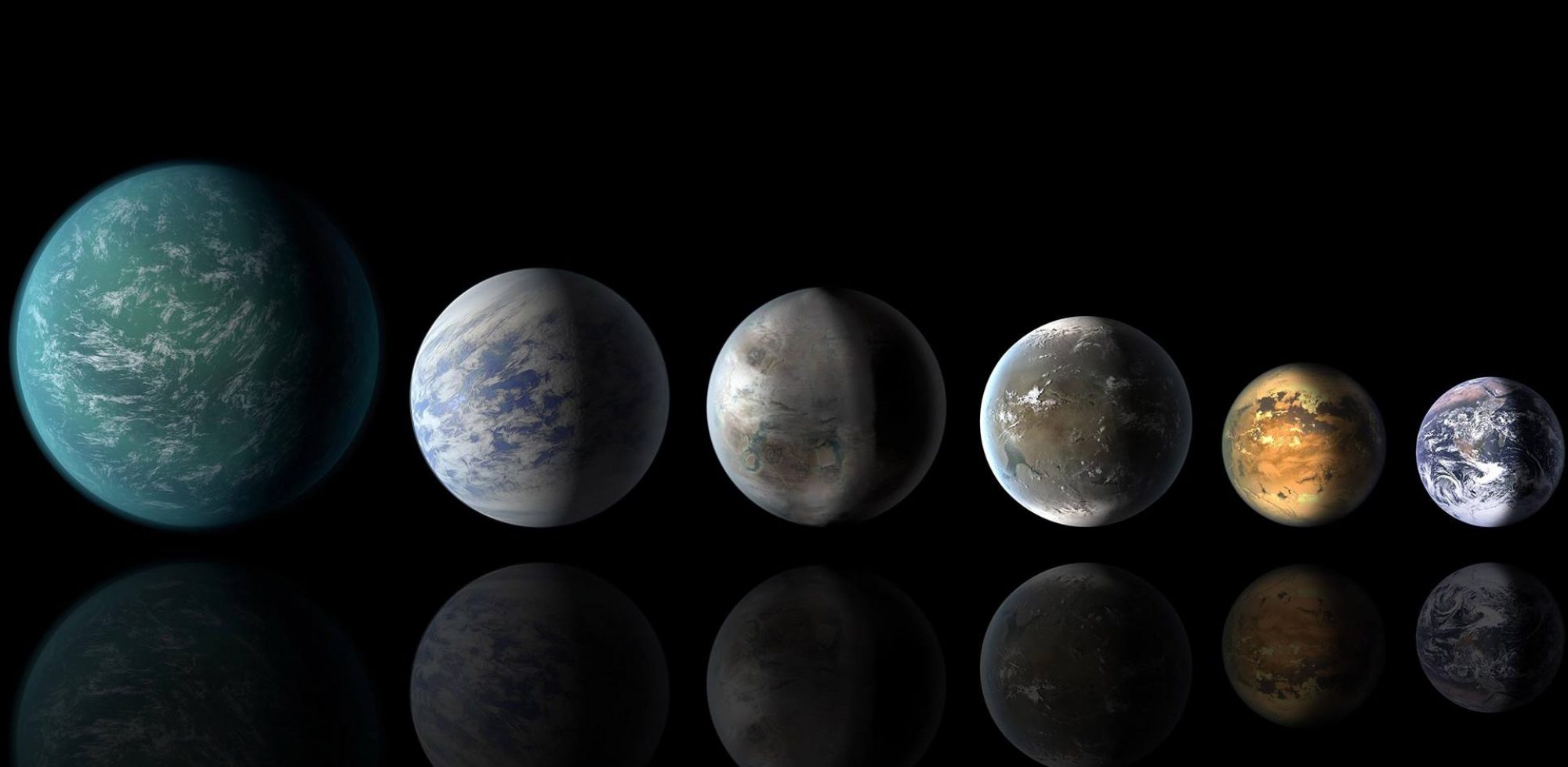
Part 2 of 2 With such a large proportion of identified exoplanets in the super-Earth to sub-Neptune class, an inescapable question arises: how conducive might they be to the origin and maintenance of life? So little is actually know about the characteristics of these planets that are larger than Earth but smaller than Neptune …
Continue reading "On Super-Earths, Sub-Neptunes and Some Lessons They Teach"
On Super-Earths, Sub-Neptunes and Some Lessons They Teach
Part 1 of 2 When the first exoplanet was identified and confirmed 20 years ago, there was enormous excitement, a sense of historic breakthrough and, with almost parallel intensity, sheer bewilderment. The planet, 51 Pegasi B, was larger than Jupiter yet orbited its parent star in 4 days. In other words, it was much closer …
Continue reading "On Super-Earths, Sub-Neptunes and Some Lessons They Teach"
 Many Worlds