Artist impression of JAXA's MMX spacecraft around Mars (JAXA). Japan in planning to launch a mission to visit the two moons of Mars in 2024. The spacecraft will touchdown on the surface of Phobos, gathering a sample to bring back to Earth. But what is so important about a moon the size of a city? …
Exactly How Like Our Earth is an Earth-like Planet?
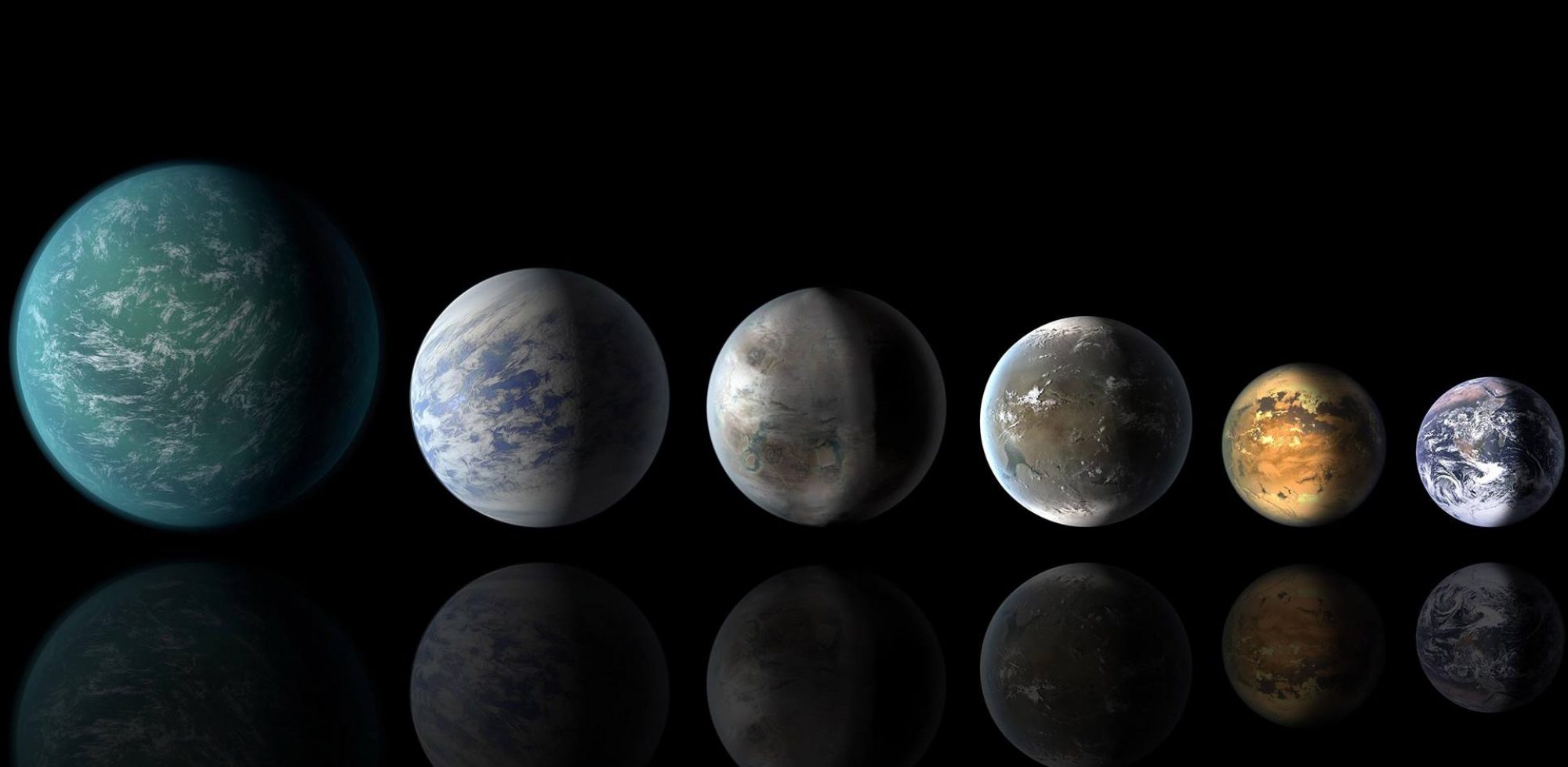
https://videopress.com/v/lEFuz7Sl?posterUrl=https%3A%2F%2Fmanyworlds.space%2Fwp-content%2Fuploads%2F2020%2F01%2FScreenshot-2020-01-27-at-22.42.43.png&preloadContent=metadata Explainer video for Earth-Like. (Vimeo edition with subtitles here) Are we alone? The question hangs over each discovery of an Earth-sized planet as we speculate on its habitability. But how different and varied could these worlds really be? Perhaps the best way to get a flavor of this potential diversity is to build a …
Continue reading "Exactly How Like Our Earth is an Earth-like Planet?"
The Giant Moon That Might Be the Heart of a Jupiter
Artist’s impression of the exomoon candidate Kepler-1625b-i, the planet it is orbiting and the star. (NASA/ESA/L. Hustak, STScI) “Moons are where planets were in the 1990s,” predicted René Heller from the Max Planck Institute for Solar System Research a few years ago. “We’re on the brink.” Heller was predicting that we were close to the …
Continue reading "The Giant Moon That Might Be the Heart of a Jupiter"
The Planets Too Big for Their Star
Artist rendering of a red dwarf , with three exoplanets orbiting. About 75% of all stars in the sky are the cooler, smaller red dwarfs. (NASA) Two giant planets have been found orbiting a tiny star, defying our theories for how planets are formed. To be entirely truthful, there is nothing new in an exoplanet …
Searching for the Edge of Habitability
Topographical map of Venus by NASA's Magellan spacecraft (1990 - 1994). Color indicates height. (NASA/JPL/USGS) How many habitable worlds like our own could exist around other stars? Since the discovery of the first exoplanets, the answer to this question has seemed tantalizingly close. But to estimate the number of Earths, we first need to understand …
Hayabusa2 Snatches Second Asteroid Sample
Artist impression of the Hayabusa2 spacecraft touching down on asteroid Ryugu (JAXA / Akihiro Ikeshita) “1… 2… 3… 4…” The counting in the Hayabusa2 control room at the Japan Aerospace Exploration Agency’s Institute of Space and Astronautical Sciences (JAXA, ISAS) took on a rhythmic beat as everyone in the room took up the chant, their …
Continue reading "Hayabusa2 Snatches Second Asteroid Sample"
Starting Life on Another Planet
A look inside the planet simulator in the Origins of Life laboratory at McMaster University. Within this chamber, the origins of life can be explored on different worlds (McMaster University). Have you ever wondered if you could kick-start life on another planet? In the Origins of Life laboratory at McMaster University in Canada, there is …
Japan’s Hayabusa2 Asteroid Mission Reveals a Remarkable New World
https://www.youtube.com/watch?v=-3hO58HFa1M The Hayabusa2 touchdown movie, taken on February 22, 2019 (JST) when Hayabusa2 first touched down on asteroid Ryugu to collect a sample from the surface. It was captured using the onboard small monitor camera (CAM-H). The video playback speed is five times faster than actual time (JAXA). On March 5 the Japan Aerospace Exploration …
Continue reading "Japan’s Hayabusa2 Asteroid Mission Reveals a Remarkable New World"
The Gale Winds of Venus Suggest How Locked Exoplanets Could Escape a Fate of Extreme Heat and Brutal Cold
More than two decades before the first exoplanet was discovered, an experiment was performed using a moving flame and liquid mercury that could hold the key to habitability on tidally locked worlds. The paper was published in a 1969 edition of the international journal, Science, by researchers Schubert and Whitehead. The pair reported that …
Does Proxima Centauri Create an Environment Too Horrifying for Life?
In 2016, the La Silla Observatory in Chile spotted evidence of possibly the most eagerly anticipated exoplanet in the Galaxy. It was a world orbiting the nearest star to the sun, Proxima Centauri, making this our closest possible exoplanet neighbour. Moreover, the planet might even be rocky and temperate. Proxima Centauri b had been …
Continue reading "Does Proxima Centauri Create an Environment Too Horrifying for Life?"
 Many Worlds
