
Few unaided celestial sights are quite so lovely and moving as the Magellanic Clouds.
An unmistakable wash of milky light in the southern hemisphere sky, I saw them once before at the European Southern Observatory’s Very Large Telescope high in Chile’s Atacama Desert, and came away smitten. I’m on an explore now in Argentina’s Patagonia and had been very much looking forward to reacquainting myself with that experience of being in the presence of such a gift. (I can’t help but think that many an astronomer who ferries back and forth to the growing number of Atacama observatories is also drawn to the nighttime show put on by the so different southern sky.)
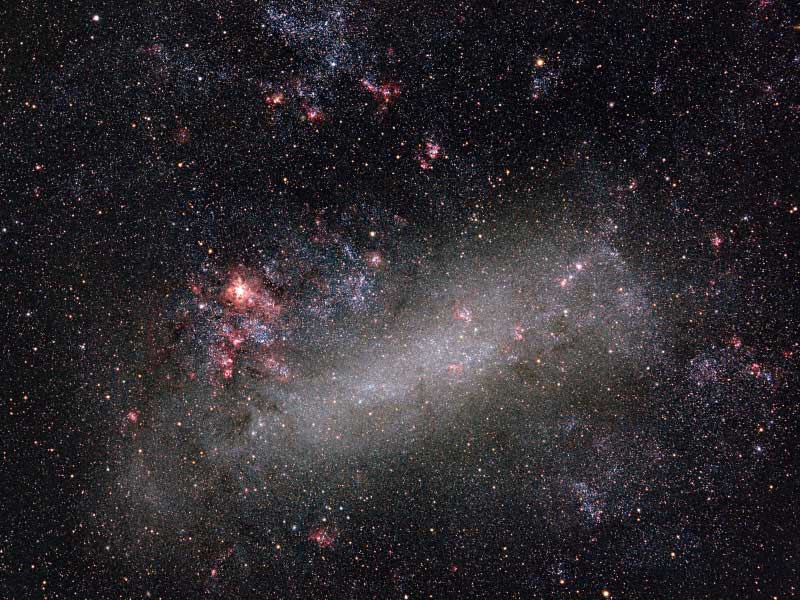
My first good “viewing” opportunity occurred in the shadow of another southern icon– the also milky whitish spire of Mount Fitz Roy (or El Chalten as originally known.) The Atacama sharpness was gone, but the Magellanics were on display. Billions of stars packed ever so closely together, they are a pleasure to see in their gauzy grace and a spur to the imagination: What, after all, would the sky look like if it was all Magellanic Clouds? A kind of sky-full of celestial Manhattans.
I wish I had spent more time with the Magellanics that night because, well, they were gone for the next five nights. There are very good reasons why observatories are built in the Atacama rather than in or near the Andes, and the absence of moisture is high on the list. I saw many more Andean clouds at night, but no more Magellanics.
But having once again experienced that stellar wash, I wanted to share some of what’s known about what they are and why they are there.
First off, there are two Magellanic Clouds – the Large and the Small. They interact with each other and, perhaps more significant, with the Milky Way. Indeed, they are dwarf galaxies within the halo of the Milky Way, orbiting our vastly larger galaxy in a timescale of billions of years.
Although the Large Magellanic Cloud is generally classified as an irregular galaxy, it shares some features with spiral galaxies, including a clearly visible bar, and a single spiral-arm-like structure. It is thought that the Large Magellenic may have been a small spiral galaxy that was reshaped by the gravitational pull of the Milky Way.
Because they are packed full of gases, the Magellanic Clouds are fertile stellar nurseries. The Large Magellanic is home, for instance, to the Tarantula Nebula, 700 light-years across and generally considered the greatest source of star creation in our galactic region. The presence of glowing nebulae, which dot the Magellanic Clouds, are a unmistakable sign that new stars are being born. Thus the closely-packed nature of the Clouds.

The two Magellanic galaxies are part of the Local Group — which consists of the Milky Way, Andromeda and Pinwheel galaxies and more than 50 dwarf “satellite” galaxies. The Local Group got its name from Edwin Hubble in 1936 by Edwin Hubble, and remains a rich field of research. Nine additional dwarf galaxies were discovered only last year by a team at Cambridge University working to understand dark matter.
Unlike most of the dwarf galaxies, the Magellanic Clouds remain filled with gases. (The Milky Way and other larger galaxies have sucked the gases from most of those others, sometimes called spheroidals.) Because the Clouds have so much gas to form stars they are bright enough to have captured the attention of naked-eye observers like Magellan’s chronicler, Antonio Pigafetta. He was struck and mesmerized, like some many others, by the “many small stars congregated together.”
The Milky Way’s other known satellites harbor up to ten million stars each. The Small Magellanic Cloud holds some three billion stars, and the Large Cloud perhaps 30 billion.
For a long time, astronomers held that the Magellanic Clouds regularly orbited the Milky Way and actually received their vast supply of gas from our galaxy. It was also considered likely that the cosmos held many Magellanic-like galaxies.
It is only in recent years that astronomers have come to understand how unusual it is to have satellite galaxies like the Magellanics so relatively close to large galaxies like our own. Their ability to hold on to so much gas is not fully understood.
There is great interest in the astronomy world about how and when the Clouds got to where they are.
In 2006 a team of astronomers using the Hubble Space Telescope measured the motion of the Magellanic Clouds by clocking them against background quasars, which lie billions of light-years beyond and so approximate a static background in a universe where nothing really stands still. These measurements suggest the clouds are pursuing vast eccentric orbits that would have brought them our galactic region only one time since the universe began.
This is how, a few years back, Ken Croswell described the research in Scientific American:
Nitya Kallivayalil, an astronomer now at Yale University, and her colleagues reported Hubble observations that tracked the motion of the Magellanic Clouds through space and began to illuminate how the Clouds have prospered while their fellow satellites atrophied. And her latest Hubble data, published in February, follow the galaxies over a longer period of time, yielding a more precise path for the pair, and strengthen her startling discovery: The Magellanic Clouds are speeding through space so fast they are likely passing us for the first time. “I was initially very surprised,” she says. But her discovery actually explains how the two galaxies have retained their youthful glow. Until recently they’ve avoided the Milky Way and its gas-grabbing tactics.
Before Kallivayalil’s work and before it became so clear that getting close to a big galaxy was bad for a smaller galaxy’s health, astronomers thought the Magellanic Clouds revolved around our galaxy every one billion or two billion years. When the Clouds came closest, the thinking went, the Milky Way’s gravity stirred up their gas, triggering the birth of new stars. The Hubble work, however, suggests that the Clouds’ orbit around us is much more enormous. Indeed, Kallivayalil’s new work rules out orbital periods less than four billion years. The two galaxies came closest to us just 200 million years ago; thus, for most of their lives, the Milky Way has had little effect on them.
Which is a good thing, because otherwise they probably would not exist.

So, are there exoplanets in the Magellanic Clouds? I asked Carnegie Institution of Washington planet-hunter Paul Butler, and he didn’t know of any. I also found none in the literature.
But along with their vast supply of gases, the Clouds are also known to have lots of the dust particles needed to form planets. Since star formation is associated with planet formation anyway, we can probably assume that planets orbit many Magellanic stars. Which makes the view even better.
 Many Worlds