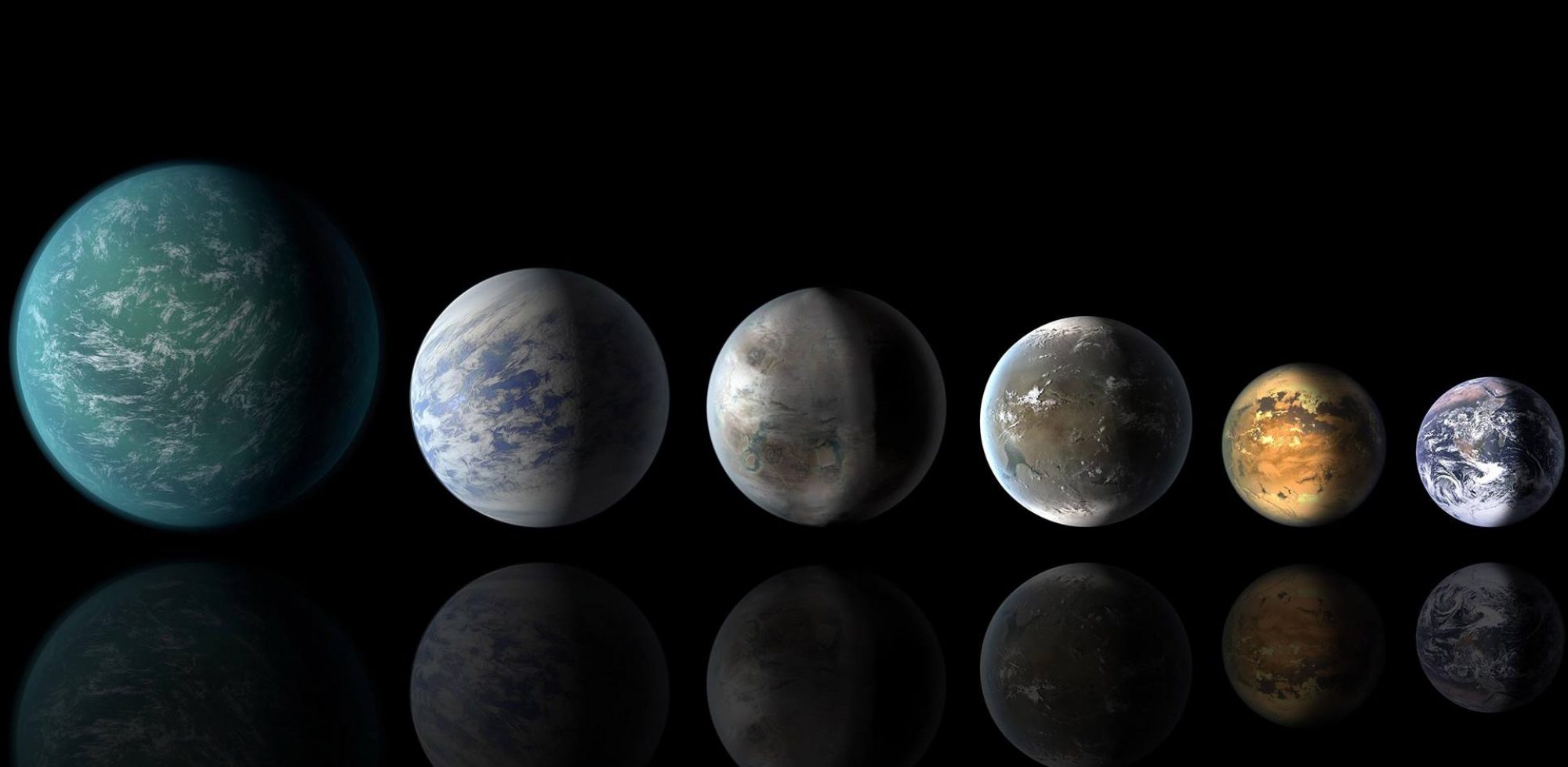
This column was written by my colleague Elizabeth Tasker, now at the Japan Aerospace Exploration Agency (JAXA), Institute of Space and Astronautical Sciences (ISAS). Trained as an astrophysicist, she researches planet and galaxy formation and also writes on space science topics. Her book, "The Planet Factory," came out last year. On January 5, 2010, NASA …
The Just-Approved European ARIEL Mission Will Be First Dedicated to Probing Exoplanet Atmospheres
The European Space Agency (ESA) has approved the ARIEL space mission—the world's first dedicated exoplanet atmosphere sniffer— to fly in 2028. ARIEL stands for the “Atmospheric Remote-sensing Infrared Exoplanet Large-Survey mission.” It is a space telescope that can detect which atoms and molecules are present in the atmosphere of an exoplanet. The mission was …
The Just-Approved European ARIEL Mission Will Be First Dedicated to Probing Exoplanet Atmospheres
This column was written by my colleague Elizabeth Tasker, now at the Japan Aerospace Exploration Agency (JAXA), Institute of Space and Astronautical Sciences (ISAS). Trained as an astrophysicist, she researches planet and galaxy formation and also writes on space science topics. Her book, "The Planet Factory," came out last year. The European Space …
Storming the One-Meter-Per-Second Barrier
When the first exoplanet was identified via the radial velocity method, the Swiss team was able to detect a wobble in the star 51 Pegasi at a rate of 50 meters per second. The wobble is the star's movement back and forth caused by the gravitational pull of the planet, and in that first case …
Continue reading "Storming the One-Meter-Per-Second Barrier"
Storming the One-Meter-Per-Second Barrier
When the first exoplanet was identified via the radial velocity method, the Swiss team was able to detect a wobble in the star 51 Pegasi at a rate of 50 meters per second. The wobble is the star's movement back and forth caused by the gravitational pull of the planet, and in that first case …
Continue reading "Storming the One-Meter-Per-Second Barrier"
Hunting for Exoplanets Via TESS
Seven years ago this month the Kepler spacecraft launched into space – the first NASA mission dedicated to searching for planets around distant stars. The goal was to conduct a census of these exoplanets, to learn whether planets are common or rare. And in particular, to understand whether planets like Earth are common or …
Hunting for Exoplanets Via TESS
Seven years ago this month the Kepler spacecraft launched into space – the first NASA mission dedicated to searching for planets around distant stars. The goal was to conduct a census of these exoplanets, to learn whether planets are common or rare. And in particular, to understand whether planets like Earth are common or …
 Many Worlds