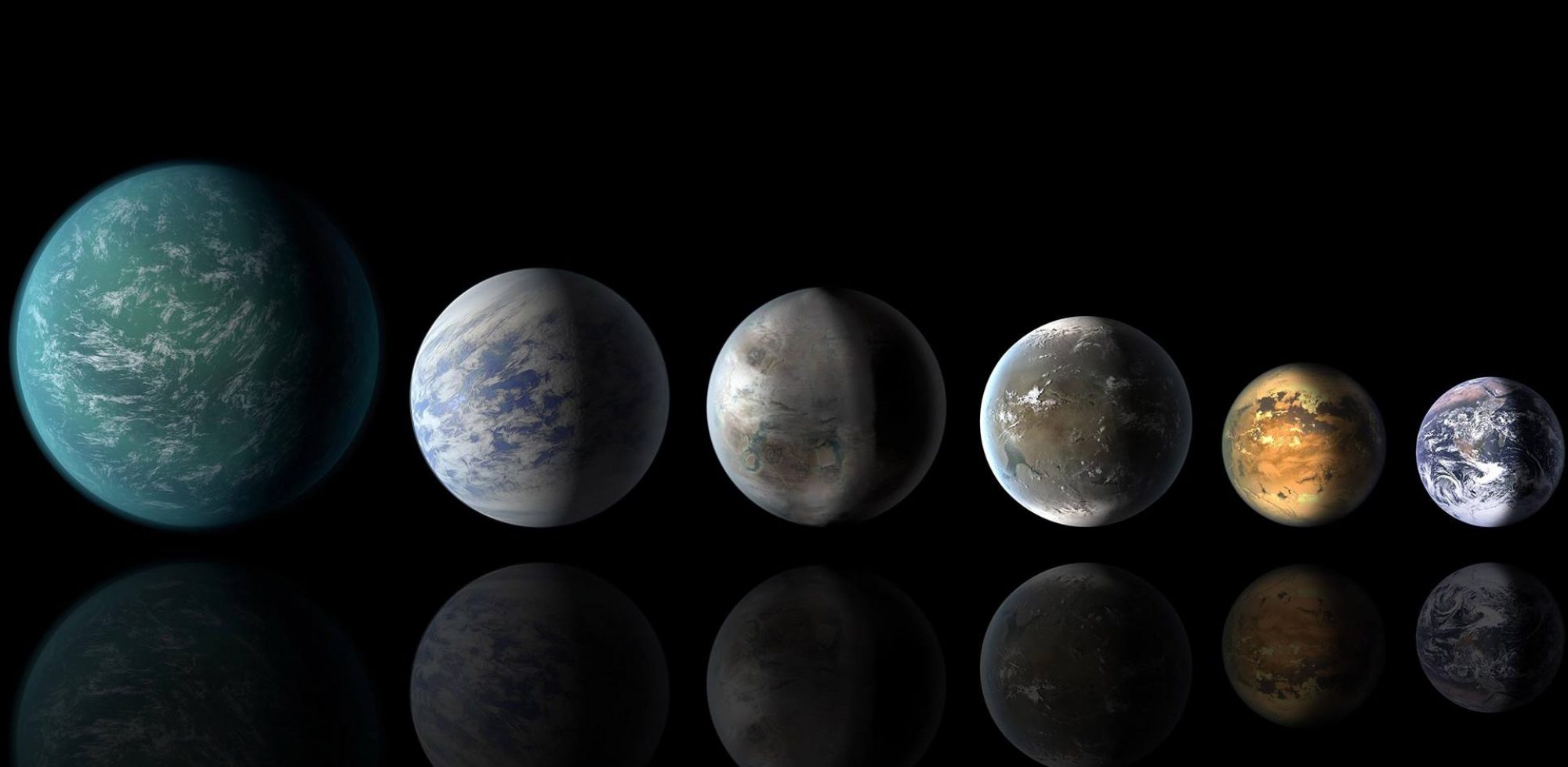
For more than two decades now, the Virtual Planetary Laboratory (VPL) at the University of Washington in Seattle has been at the forefront of the crucial and ever-challenging effort to model how scientists can determine whether a particular exoplanet is capable of supporting life or perhaps even had life on it already. To do this, …
Could Life Exist in the Clouds of Venus?
Nightside of Venus captured with the IR2 (infrared) camera on JAXA's Akatsuki climate orbiter (JAXA). On September 14 at 3pm GMT, an embargo lifted on a research paper reporting evidence for biological activity on Venus. Speculation about the discovery had been spreading rapidly through social media for several days, proving that scientists are incapable of …
“Agnostic Biosignatures,” And The Path To Life As We Don’t Know It
Biosignatures -- evidence that says or suggests that life has once been present -- are often very hard to find and interpret. Scientists examining fossilized life on Earth can generally reach some sort of agreement about what is before them, but what about the soft-bodied or even single-celled organisms that were the sum total of …
Continue reading "“Agnostic Biosignatures,” And The Path To Life As We Don’t Know It"
Joining the Microscope and the Telescope in the Search for Life Beyond Earth
The world of biology is filled with labs where living creatures are cultured and studied, where the dynamics of life are explored and analyzed to learn about behavior, reproduction, structure, growth and so much more. In the field of astrobiology, however, you don't see much lab biology -- especially when it comes to …
Continue reading "Joining the Microscope and the Telescope in the Search for Life Beyond Earth"
Joining the Microscope and the Telescope in the Search for Life Beyond Earth
The world of biology is filled with labs where living creatures are cultured and studied, where the dynamics of life are explored and analyzed to learn about behavior, reproduction, structure, growth and so much more. In the field of astrobiology, however, you don't see much lab biology -- especially when it comes to …
Continue reading "Joining the Microscope and the Telescope in the Search for Life Beyond Earth"
False Positives, False Negatives; The World of Distant Biosignatures Attracts and Confounds
What observations, or groups of observations, would tell exoplanet scientists that life might be present on a particular distant planet? The most often discussed biosignature is oxygen, the product of life on Earth. But while oxygen remains central to the search for biosignatures afar, there are some serious problems with relying on that molecule. It …
False Positives, False Negatives; The World of Distant Biosignatures Attracts and Confounds
What observations, or groups of observations, would tell exoplanet scientists that life might be present on a particular distant planet? The most often discussed biosignature is oxygen, the product of life on Earth. But while oxygen remains central to the search for biosignatures afar, there are some serious problems with relying on that molecule. It …
Putting Together a Community Strategy To Search for Extraterrestrial Life
I regret that the formatting of this column was askew earlier; I hope it didn't make reading too difficult. But now those problems are fixed. Behind the front page space science discoveries that tell us about the intricacies and wonders of our world are generally years of technical and intellectual development, years of planning and …
Continue reading "Putting Together a Community Strategy To Search for Extraterrestrial Life"
A New Way to Find Signals of Habitable Exoplanets?
The search for biosignatures in the atmospheres of distant exoplanets is extremely difficult and time-consuming work. The telescopes that can potentially take the measurements required are few and more will come only slowly. And for the current and next generation of observatories, staring at a single exoplanet long enough to get a measurement of the …
Continue reading "A New Way to Find Signals of Habitable Exoplanets?"
A New Way to Find Signals of Habitable Exoplanets?
The search for biosignatures in the atmospheres of distant exoplanets is extremely difficult and time-consuming work. The telescopes that can potentially take the measurements required are few and more will come only slowly. And for the current and next generation of observatories, staring at a single exoplanet long enough to get a measurement of the …
Continue reading "A New Way to Find Signals of Habitable Exoplanets?"
 Many Worlds