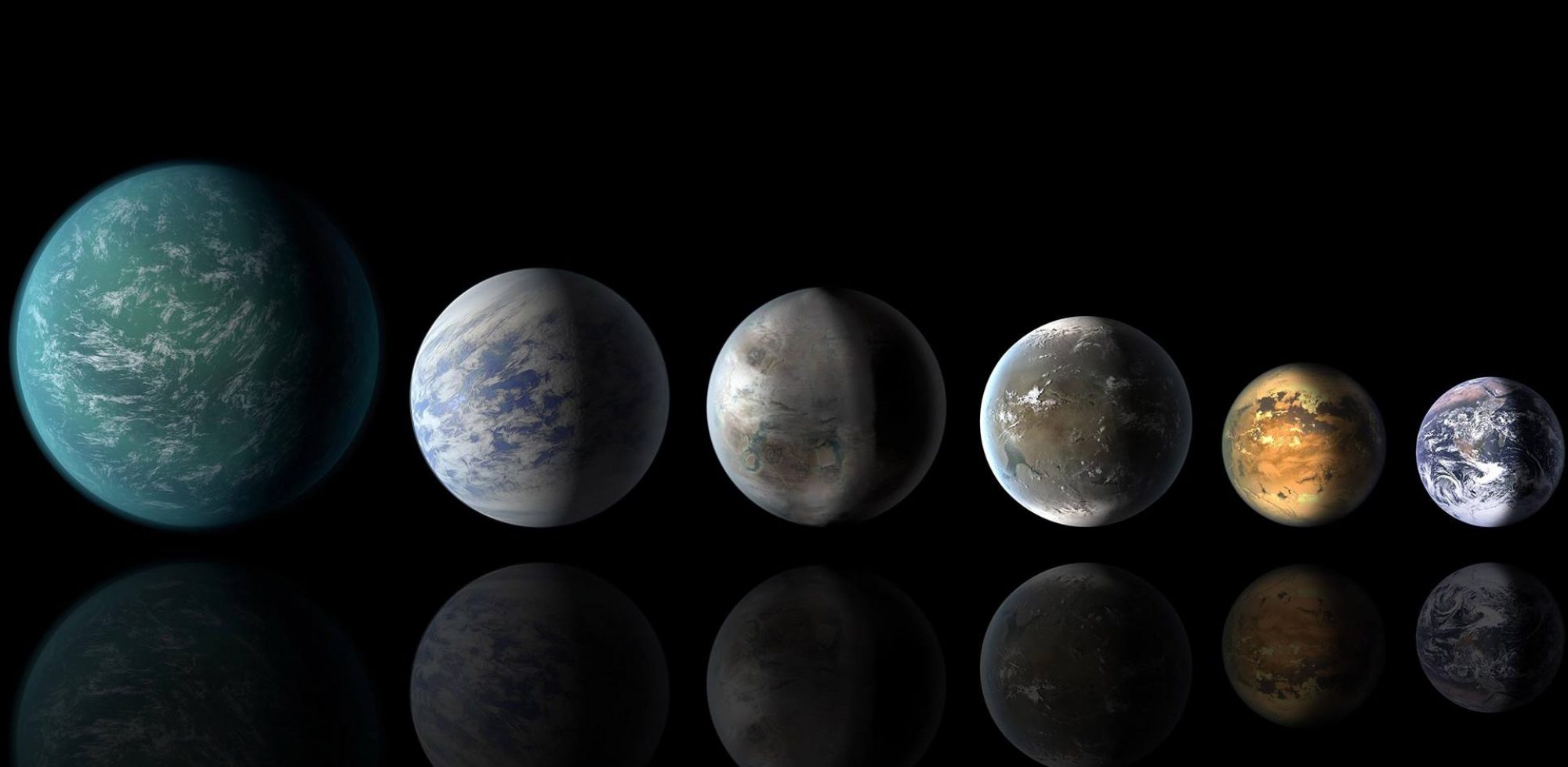
For more than two decades now, the Virtual Planetary Laboratory (VPL) at the University of Washington in Seattle has been at the forefront of the crucial and ever-challenging effort to model how scientists can determine whether a particular exoplanet is capable of supporting life or perhaps even had life on it already. To do this, …
The James Webb Space Telescope And Its Exoplanet Mission (Part 1)
The last time Many Worlds wrote about the James Webb Space Telescope, it was in the process of going through a high-stakes, super-complicated unfurling. About 50 autonomous deployments needed to occur after launch to set up the huge system, with 344 potential single point failures to overcome--individual steps that had to work for …
Continue reading "The James Webb Space Telescope And Its Exoplanet Mission (Part 1)"
A Call To Action on Ensuring That Extraordinary Claims About ET Life Come With Extraordinary Evidence
The global scientific search for signs of life beyond Earth has produced cutting-edge and paradigm-shifting science for several decades now, and it has clearly found eager audiences around the world. This search is a high-priority goal of NASA and other space agencies, as well as institutions, universities and companies. While the successes in this broadly …
New Insights Into How Earth Got Its Nitrogen
Scientists have long held that many of the important compounds and elements that make life possible on Earth arrived here after the planet was formed and was orbiting the sun. These molecules came via meteorites and comets, it was thought, from the colder regions beyond Jupiter. But in a challenge to that long-accepted view, a …
Continue reading "New Insights Into How Earth Got Its Nitrogen"
Exploring Our Sun Will Help Us Understand Habitability
The surface of the sun, with each "kernel" or "cell" roughly the size of Texas. The movie is made up of images produced by the Daniel Inouye SolarTelescope in Hawaii. Novel and even revolutionary data and images are also expected from the Parker Solar Probe (which will travel into the sun's atmosphere, or corona) and …
Continue reading "Exploring Our Sun Will Help Us Understand Habitability"
“Agnostic Biosignatures,” And The Path To Life As We Don’t Know It
Biosignatures -- evidence that says or suggests that life has once been present -- are often very hard to find and interpret. Scientists examining fossilized life on Earth can generally reach some sort of agreement about what is before them, but what about the soft-bodied or even single-celled organisms that were the sum total of …
Continue reading "“Agnostic Biosignatures,” And The Path To Life As We Don’t Know It"
NExSS 2.0
The Nexus for Exoplanet System Science, or “NExSS,” began four years ago as a NASA initiative to bring together a wide range of scientists involved generally in the search for life on planets outside our solar system. With teams from seventeen academic and NASA centers, NExSS was founded on the conviction that this search …
The Moon-Forming Impact And Its Gifts
The question of how life-essential elements such as carbon, nitrogen and sulfur came to our planet has been long debated and is a clearly important and slippery scientific subject. Did these volatile elements accrete onto the proto-Earth from the sun's planetary disk as the planet was being formed? Did they arrive substantially later …
The Kepler Space Telescope Mission Is Ending But Its Legacy Will Keep Growing.
The Kepler Space Telescope is dead. Long live the Kepler. NASA officials announced on Tuesday that the pioneering exoplanet survey telescope -- which had led to the identification of almost 2,700 exoplanets -- had finally reached its end, having essentially run out of fuel. This is after nine years of observing, after a malfunctioning …
Continue reading "The Kepler Space Telescope Mission Is Ending But Its Legacy Will Keep Growing."
A New Frontier for Exoplanet Hunting
The first exoplanets were all found using the radial velocity method of measuring the "wobble" of a star -- movement caused by the gravitational pull of an orbiting planet. Radial velocity has been great for detecting large exoplanets relatively close to our solar system, for assessing their mass and for finding out how long …
 Many Worlds