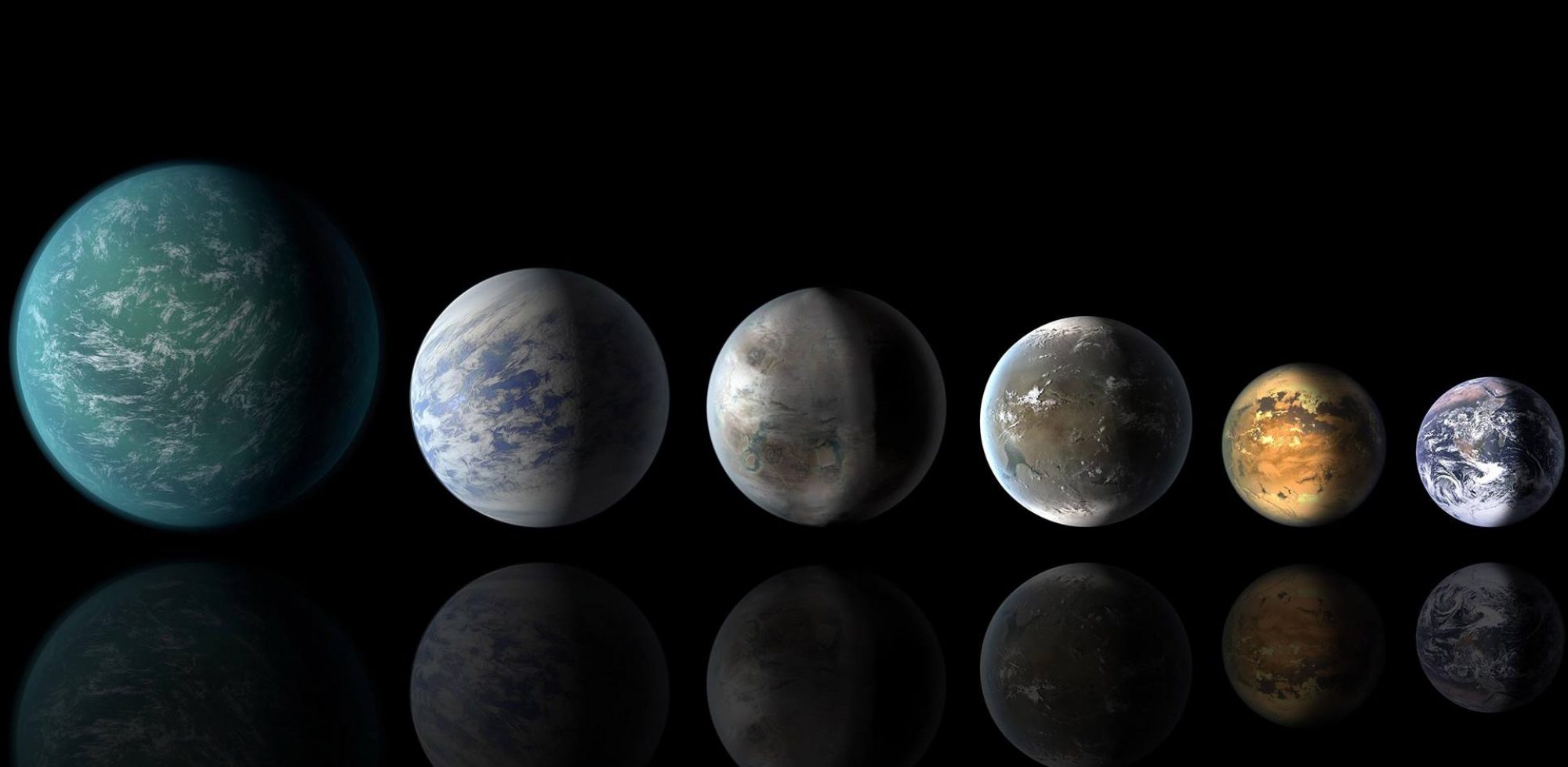
That fields of science can benefit greatly from cross-fertilization with other disciplines is hardly a new idea. We have, after all, long-standing formal disciplines such as biogeochemistry -- a mash-up of many fields that has the potential to tell us more about the natural environment than any single approach. Astrobiology in another field that inherently …
Storming the One-Meter-Per-Second Barrier
When the first exoplanet was identified via the radial velocity method, the Swiss team was able to detect a wobble in the star 51 Pegasi at a rate of 50 meters per second. The wobble is the star's movement back and forth caused by the gravitational pull of the planet, and in that first case …
Continue reading "Storming the One-Meter-Per-Second Barrier"
Ranking Exoplanet Habitability
Now that we know that there are billions and billions of planets beyond our solar system, and we even know where thousands of confirmed and candidate planets are located, where should we be looking for those planets that could in theory support extraterrestrial life, and might just possibly support it now? The first order …
Hunting for Exoplanets Via TESS
Seven years ago this month the Kepler spacecraft launched into space – the first NASA mission dedicated to searching for planets around distant stars. The goal was to conduct a census of these exoplanets, to learn whether planets are common or rare. And in particular, to understand whether planets like Earth are common or …
The Habitable Zone Gets Poked, Tweaked and Stretched to the Limits
For more than 20 years now -- even before the first detection of an extra-solar planet -- scientists have posited, defined and then debated the existence and nature of a habitable zone. It's without a doubt a central scientific concept, and the idea has caught on with the public (and the media) too. The discovery …
Continue reading "The Habitable Zone Gets Poked, Tweaked and Stretched to the Limits"
The Search for Exoplanet Life Goes Broad and Deep
I had the good fortune several years ago to spend many hours in meetings of the science teams for the Curiosity rover, listening in on discussions about what new results beamed back from Mars might mean about the planet's formation, it's early history, how it gained and lost an atmosphere, whether it was a place …
Continue reading "The Search for Exoplanet Life Goes Broad and Deep"
Cloudy, With a Chance of Iron Rain
From an Earth-centric point of view, rain of course means falling water. We can have storms with falling dust -- I experienced a few of those while a reporter in India -- but rain is pretty much exclusively H2O falling from the clouds. But as the study of exoplanets moves aggressively into the realm …
Shredding Exoplanets, And The Mysteries They May Unravel
One of the seemingly quixotic goals of exoplanet scientists is to understand the chemical and geo-chemical compositions of the interiors of the distant planets they are finding. Learning whether a planet is largely made up of silicon or magnesium or iron-based compounds is essential to some day determining how and where specific exoplanets were …
Continue reading "Shredding Exoplanets, And The Mysteries They May Unravel"
How Planet 9 Would Make Ours a More Typical Solar System
There’s been a ton of justifiable excitement these days about the possible discovery of a ninth planet in our solar system — an object ten time the mass of Earth and 200 times further from the sun. Especially in the context of the recent demotion of Pluto from a planet to a dwarf planet, …
Continue reading "How Planet 9 Would Make Ours a More Typical Solar System"
The Pale Red Dot Campaign
Astronomers have been trying for decades to find a planet orbiting Proxima Centauri, the star closest to our sun and so a natural and tempting target. Claims of an exoplanet discovery have been made before, but so far none have held up. Now, in a novel and very public way, a group of European astronomers …
 Many Worlds