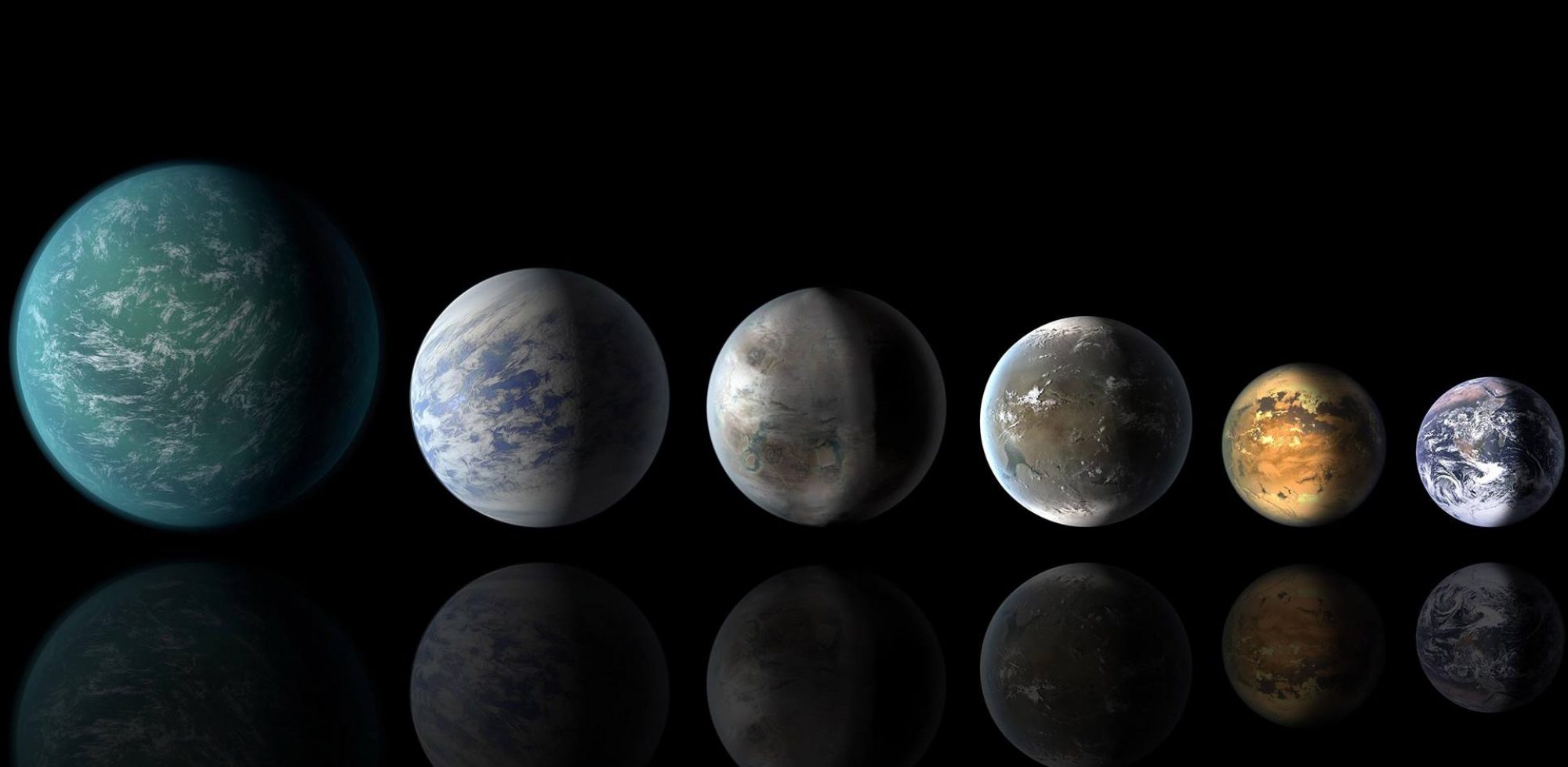
The media was abuzz last week with the latest NASA news conference. A neural network -- a form of artificial intelligence or machine learning -- developed at Google had found two planets in data previously collected by NASA’s prolific Kepler Space Telescope. It’s a technique that could ultimately track-down our most Earth-like planets. The new …
A New Way to Find Signals of Habitable Exoplanets?
The search for biosignatures in the atmospheres of distant exoplanets is extremely difficult and time-consuming work. The telescopes that can potentially take the measurements required are few and more will come only slowly. And for the current and next generation of observatories, staring at a single exoplanet long enough to get a measurement of the …
Continue reading "A New Way to Find Signals of Habitable Exoplanets?"
Can You Overwater a Planet?
Water worlds, especially if they have no land on them, are unlikely to be home to life, or at least life we can detect. Some of the basic atmospheric and mineral cycles that make a planet habitable will be absent. Cool animation of such a world. (NASA) Wherever we find water on Earth, we find …
Red Dwarf Stars and the Planets Around Them
It's tempting to look for habitable planets around red dwarf stars, which put out far less luminosity and so are less blinding. But is it wise? That question has been near the top of the list for many exoplanet scientists, especially those involved in the search for habitable worlds. Red dwarfs are plentiful (about three-quarters …
Continue reading "Red Dwarf Stars and the Planets Around Them"
Primordial Asteroids, And The Stories They Are Telling
Asteroid, we've long been told, started tiny in our protoplanetary disk and only very gradually became more massive through a process of accretion. They collected dust from the gas cloud that surrounded our new star, and then grew larger through collisions with other growing asteroids. But in recent years, a new school of thought …
Continue reading "Primordial Asteroids, And The Stories They Are Telling"
In Search of Panspermia (and Life on Icy Moons)
Sometimes personal affairs intervene for all of us, and they have now for your Many Worlds writer and his elderly father. But rather than remain off the radar screen, I wanted to repost this column which has a new import. It turns out that versions of the instrument described below -- a miniature gene …
Continue reading "In Search of Panspermia (and Life on Icy Moons)"
Getting Real About the Oxygen Biosignature
I remember the first time I heard about the atmospheres of distant exoplanets and how could and would let us know whether life was present below. The key was oxygen or its light-modified form, ozone. Because both oxygen and ozone molecules bond so quickly with other molecules -- think rust or iron oxide on …
Continue reading "Getting Real About the Oxygen Biosignature"
Elegant Image of Icy Disk Around The Young Fomalhaut System
An international team of astronomers using the Atacama Large Millimeter/submillimeter Array (ALMA) has made the first complete millimeter-wavelength image of the ring of dusty debris surrounding the young star Fomalhaut. This well-defined band of rubble and gas is likely the result of comets smashing together near the outer edges of a planetary system 25 light-years from …
Continue reading "Elegant Image of Icy Disk Around The Young Fomalhaut System"
Planetary Protection is a "Wicked" Problem
The only time that a formally designated NASA "life detection" mission was flown to another planet or moon was when the two Viking landers headed to Mars forty years ago. The odds of finding some kind of Martian life seemed so promising at the time that there was little dispute about how much energy, money …
Continue reading "Planetary Protection is a "Wicked" Problem"
The Very Influential Natalie Batalha
I'd like to make a slight detour and talk not about the science of exoplanets and astrobiology, but rather a particular exoplanet scientist who I've had the pleasure to work with. The scientist is Natalie Batalha, who has been lead scientist for NASA's landmark Kepler Space Telescope mission since soon after it launched in 2009, …
 Many Worlds