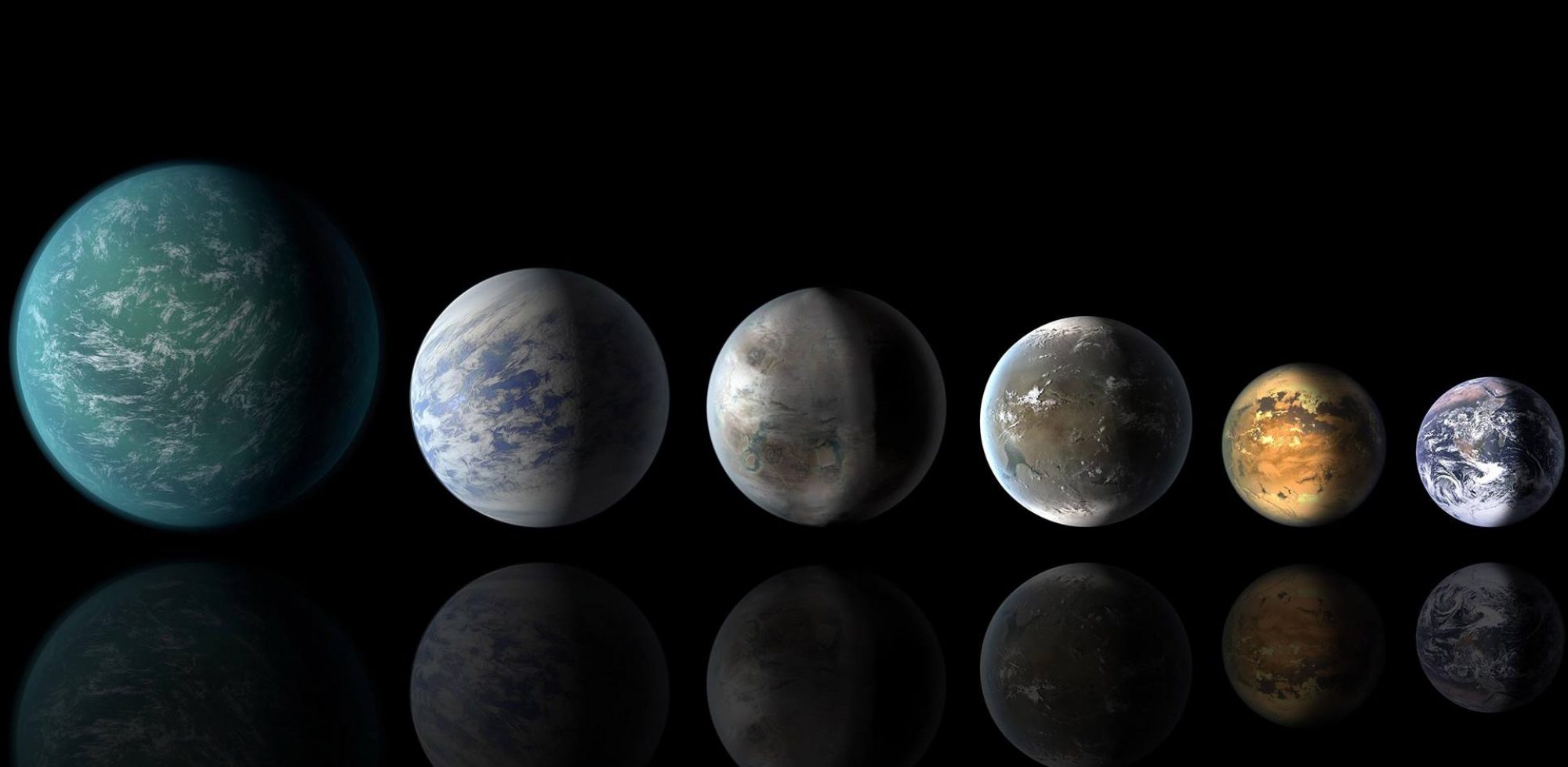
No exoplanet can possibly be closer to us than the one just detected around our nearest stellar neighbor, Proxima Centauri. The long-sought and long-imagined planet is larger than Earth, but small enough to be rocky as opposed to a gas or ice giant. Making things even more exciting, the planet was detected inside the habitable …
Earth: A Prematurely Inhabited Planet?
The study of the formation and logic of the universe (cosmology) and the study of exoplanets and their conduciveness to life do not seem to intersect much. Scientists in one field focus on the deep physics of the cosmos while the others search for the billions upon billions of planets out there and seek to …
The Ever More Puzzling, And Intriguing, "Tabby’s Star."
Substantial, sun-like stars are not supposed to dim. They start with gravity and pressure induced nuclear reactions, and then they burn brighter and brighter until they either explode (go supernova) or burn all their fuel and become small, enormously dense, and not very bright "white dwarfs." Of course, the transit technique of searching for exoplanets …
Continue reading "The Ever More Puzzling, And Intriguing, "Tabby’s Star.""
Coming to Terms With Biosignatures
The search for life beyond our solar system has focused largely on the detection of an ever-increasing number of exoplanets, determinations of whether the planets are in a habitable zone, and what the atmospheres of those planets might look like. It is a sign of how far the field has progressed that scientists are now …
Rocky, Close and Potentially Habitable Planets Around a Dwarf Star
Forty light-years away is no small distance. But an announcement of the discovery of two planets at that separation that have been determined to be rocky and Earth-sized adds a significant new twist to the ever-growing collection of relatively close-by exoplanets that just might be habitable. The two planets in the TRAPPIST-1 system orbit what …
Continue reading "Rocky, Close and Potentially Habitable Planets Around a Dwarf Star"
Rethinking The Snow Line
In every planet-forming disk there's a point where the heat from a host star needed to keep H2O molecules as vapor peters out, and the H2O be becomes a solid crystal. This is the snow line, and it looms large in most theories of planet formation. Most broadly, planets formed inside the snow line will …
Three Star Ballet, With Exoplanet
It hardly seems possible, but researchers have detected a planet in apparently stable orbit within a three star system -- a configuration now known as a trinary. The ubiquity of binary stars has been understood for some time, and the presence of exoplanets orbiting around and within them is no longer a surprise. But this …
Juno Now Orbiting Jupiter
It took a while -- almost five years since launch -- but the Juno spacecraft is now at Jupiter and orbiting the giant planet. A 35-minute rocket burn to slow Juno down from its record-breaking 130,000 mph entry speed led to a successful insertion into orbit just minutes before midnight, making it another July 4th …
Exoplanet Biosignatures: Crucial and Confounding
Early in the Curiosity rover's trek across Gale Crater on Mars, team member and Los Almos National Laboratory planetary scientist Nina Lanza reported finding surprisingly high concentrations of the mineral manganese oxide. It was showing up as a blackish-purple fill to cracks in rocks, and possibly as a surface covering to others. Lanza, who had …
Continue reading "Exoplanet Biosignatures: Crucial and Confounding"
Juno, Jupiter and Exo-Jupiters
The last NASA mission to orbit Jupiter, the Galileo, was designed, flown and its data analyzed as if it was circling the only Jupiter in the sky. This is hardly surprising since the spacecraft launched in 1989, before the exoplanet era had arrived. Ironically, Galileo entered its Jupiter orbit in late 1995, just a few …
 Many Worlds