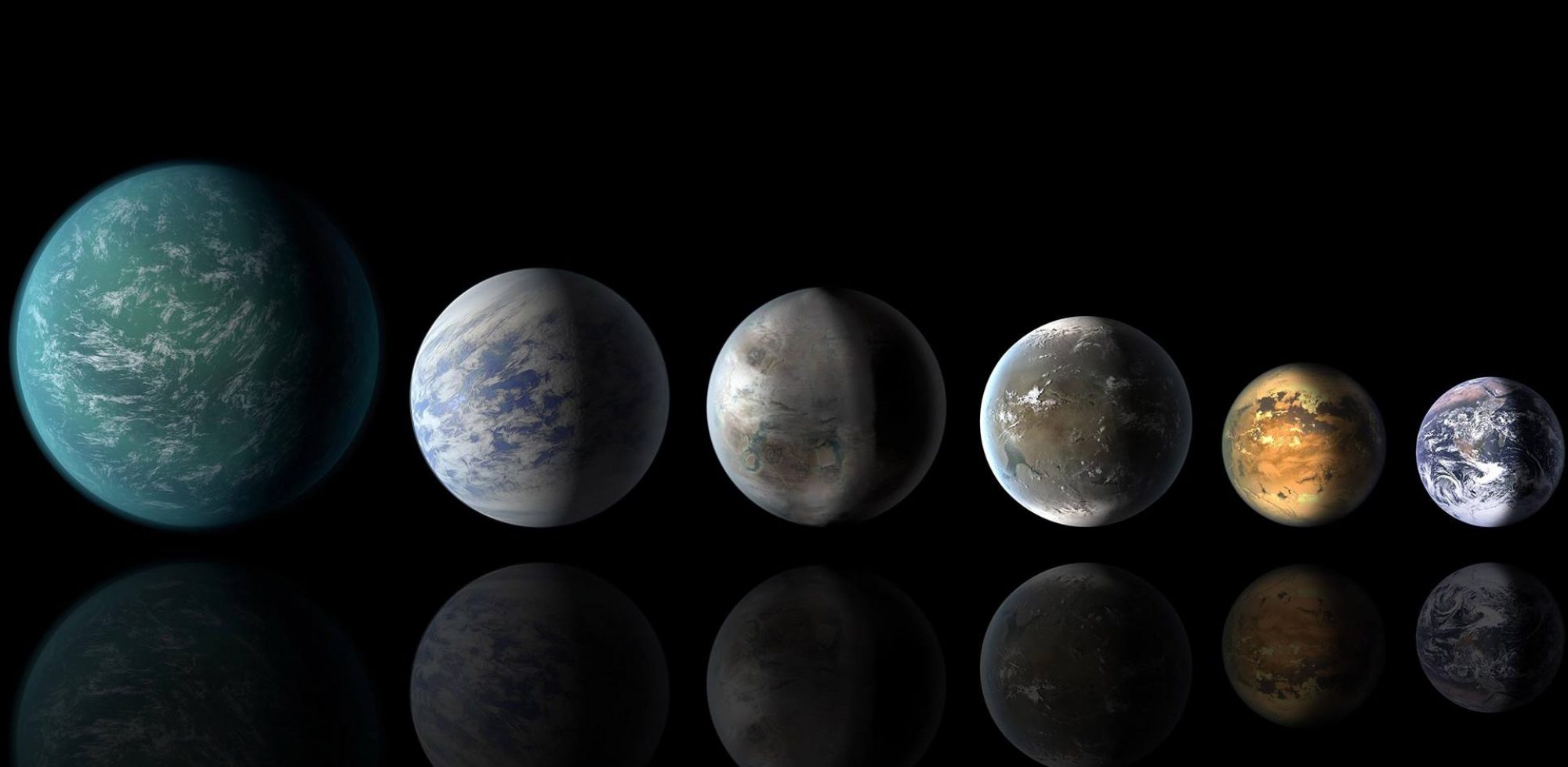
When especially interesting new planets are discovered in the cosmos, scientists around the world begin the process of identifying their characteristics -- their orbit, their mass and density, their composition, their thermal properties and much more. It's all part of a drive that seems to be innate in humans to learn about the workings of …
Tatooine Worlds
When the the first Star Wars movie came out in 1977, it featured the now-iconic two-sun, "circumbinary" planet Tatooine. At that time astronomers didn't really know if such solar systems existed, with more than one sun and at least one planet. Indeed, the first extra-solar planet wasn't detected until the early 1990s. And the first …
Using Climate Science on Earth to Understand Planets Beyond Earth
Anthony Del Genio started out his career expecting to become first an engineer and then a geophysicist. He was in graduate school at UCLA and had been prepared by previous mentors to enter the geophysics field. But a 1973 department-wide test focused on seismology, rather than fields that he understood better, and his days as …
Continue reading "Using Climate Science on Earth to Understand Planets Beyond Earth"
How Long Were the Wet Periods on Early Mars, and Was That Water Chemically Suitable For Life?
There is no doubt that early Mars had long period of warmer and much wetter climates before its atmosphere thinned too much to retain that liquid H20 on the surface. As we know from the Curiosity mission to Gale Crater and other orbital findings, regions of that warmer and wetter Mars had flowing water …
Icy Moons and Their Plumes
Just about everything that scientists see as essential for extraterrestrial life -- carbon, hydrogen, oxygen, nitrogen, phosphorus, sulfur and sources of energy -- is now known to be pretty common in our solar system and beyond. It's basically there for the taking by untold potential forms of life. But what is not at all common …
Mapping Titan, the Most Earth-Like Body in Our Solar System
Saturn's moon Titan has lakes and rivers of liquid hydrocarbons, temperatures that hover around -300 degrees Fahrenheit, and a thick haze that surrounds it and has cloaked it in mystery. An unusual place for sure, but perhaps what's most unusual is that Titan more closely resembles Earth of all the planets and moons in our …
Continue reading "Mapping Titan, the Most Earth-Like Body in Our Solar System"
A Southern Sky Extravaganza From TESS
Candidate exoplanets as seen by TESS in a southern sky mosaic from 13 observing sectors. (NASA/MIT/TESS) NASA’s Transiting Exoplanet Survey Satellite (TESS) has finished its one year full-sky observation of Southern sky and has found hundreds of candidate exoplanets and 29 confirmed planets. It is now maneuvering its array of wide-field telescopes and cameras to …
A Telling Nobel Exoplanet Faux Pas
Given the complex history of the discovery and announcement in 1995 of the first exoplanet that orbits a sun-like star, it is perhaps no surprise that errors might sneak into the retelling. Two main groups were racing to be first, and for a variety of reasons the discovery ended up being confirmed before it was …
PIXL: A New NASA Instrument For Ferreting Out Clues of Ancient Life on Mars
The search for life, or signs of past life beyond Earth is now a central issue in space science, is central to the mission of NASA, and is actually a potentially breakthrough discovery in the making for humanity. The scientific stakes could hardly be higher. But identifying evidence of ancient microbial life – and …
Continue reading "PIXL: A New NASA Instrument For Ferreting Out Clues of Ancient Life on Mars"
The Remarkable Race to Find the First Exoplanet, And the Nobel Prize It Produced
Earlier this week, the two men who detected the first planet outside our solar system that circled a sun-like star won a Nobel Prize in physics. The discovery heralded the beginning of the exoplanet era -- replacing a centuries-old scientific supposition that planets orbited other stars with scientific fact. The two men are Michel Mayor, …
Continue reading "The Remarkable Race to Find the First Exoplanet, And the Nobel Prize It Produced"
 Many Worlds