It's been eight months since citizen "Planet Hunters" working with Yale postdoc Tabetha Boyajian announced the discovery of a most unusual star, or rather a star where something most unusual was intermittently and erratically happening. The puzzle began with some light curve data, taken over a four year period, by the Kepler Space Telescope The …
Big Bangs
What can get the imagination into super-drive more quickly than the crashing of really huge objects? Like when a Mars-sized planet did a head-on into the Earth and, the scientific consensus says, created the moon. Or when a potentially dinosaur-exterminating asteroid heads towards Earth, or when what are now called "near-Earth objects" seems to be …
A Flood of Newly Confirmed Exoplanets
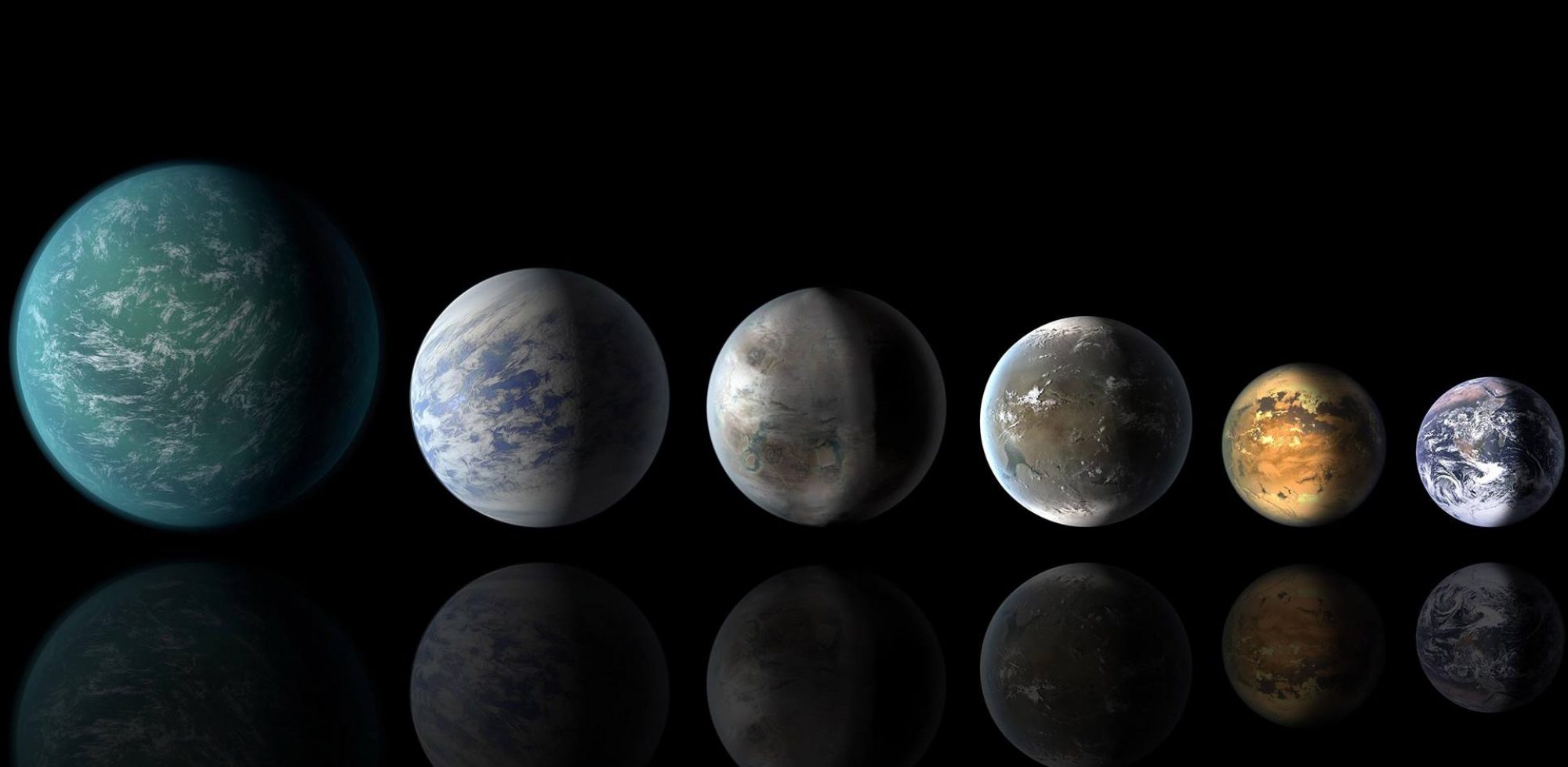
In the biggest haul ever of new exoplanets, scientists with NASA's Kepler mission announced the confirmation of 1,284 additional planets outside our solar system -- including nine that are relatively small and within the habitable zones of their host stars. That almost doubles the number of these treasured rocky planets that orbit their stars at …
Out of the Stovepipes and Into the Galaxy
This “Many Worlds” post is written by Andrew Rushby, a postdoctoral fellow from the United Kingdom who recently began working with NASA's NExSS initiative. The column will hopefully serve to both introduce this new NExSS colleague and to let him share his thoughts about the initiative and what lies ahead. I’m most excited to join …
Continue reading "Out of the Stovepipes and Into the Galaxy"
A Dwarf Star Produces a Major Discovery
The detection of potentially habitable exoplanets is not the big news it once was -- there have been so many identified already that the novelty has faded a bit. But that hardly means surprising and potentially breakthrough discoveries aren't being made. They are, and one of them was just announced Monday. This is how the …
Breaking Down Exoplanet Stovepipes
That fields of science can benefit greatly from cross-fertilization with other disciplines is hardly a new idea. We have, after all, long-standing formal disciplines such as biogeochemistry -- a mash-up of many fields that has the potential to tell us more about the natural environment than any single approach. Astrobiology in another field that inherently …
Storming the One-Meter-Per-Second Barrier
When the first exoplanet was identified via the radial velocity method, the Swiss team was able to detect a wobble in the star 51 Pegasi at a rate of 50 meters per second. The wobble is the star's movement back and forth caused by the gravitational pull of the planet, and in that first case …
Continue reading "Storming the One-Meter-Per-Second Barrier"
The Magellanics
Few unaided celestial sights are quite so lovely and moving as the Magellanic Clouds. An unmistakable wash of milky light in the southern hemisphere sky, I saw them once before at the European Southern Observatory’s Very Large Telescope high in Chile’s Atacama Desert, and came away smitten. I’m on an explore now in Argentina's Patagonia …
Ranking Exoplanet Habitability
Now that we know that there are billions and billions of planets beyond our solar system, and we even know where thousands of confirmed and candidate planets are located, where should we be looking for those planets that could in theory support extraterrestrial life, and might just possibly support it now? The first order …
Hunting for Exoplanets Via TESS
Seven years ago this month the Kepler spacecraft launched into space – the first NASA mission dedicated to searching for planets around distant stars. The goal was to conduct a census of these exoplanets, to learn whether planets are common or rare. And in particular, to understand whether planets like Earth are common or …
 Many Worlds