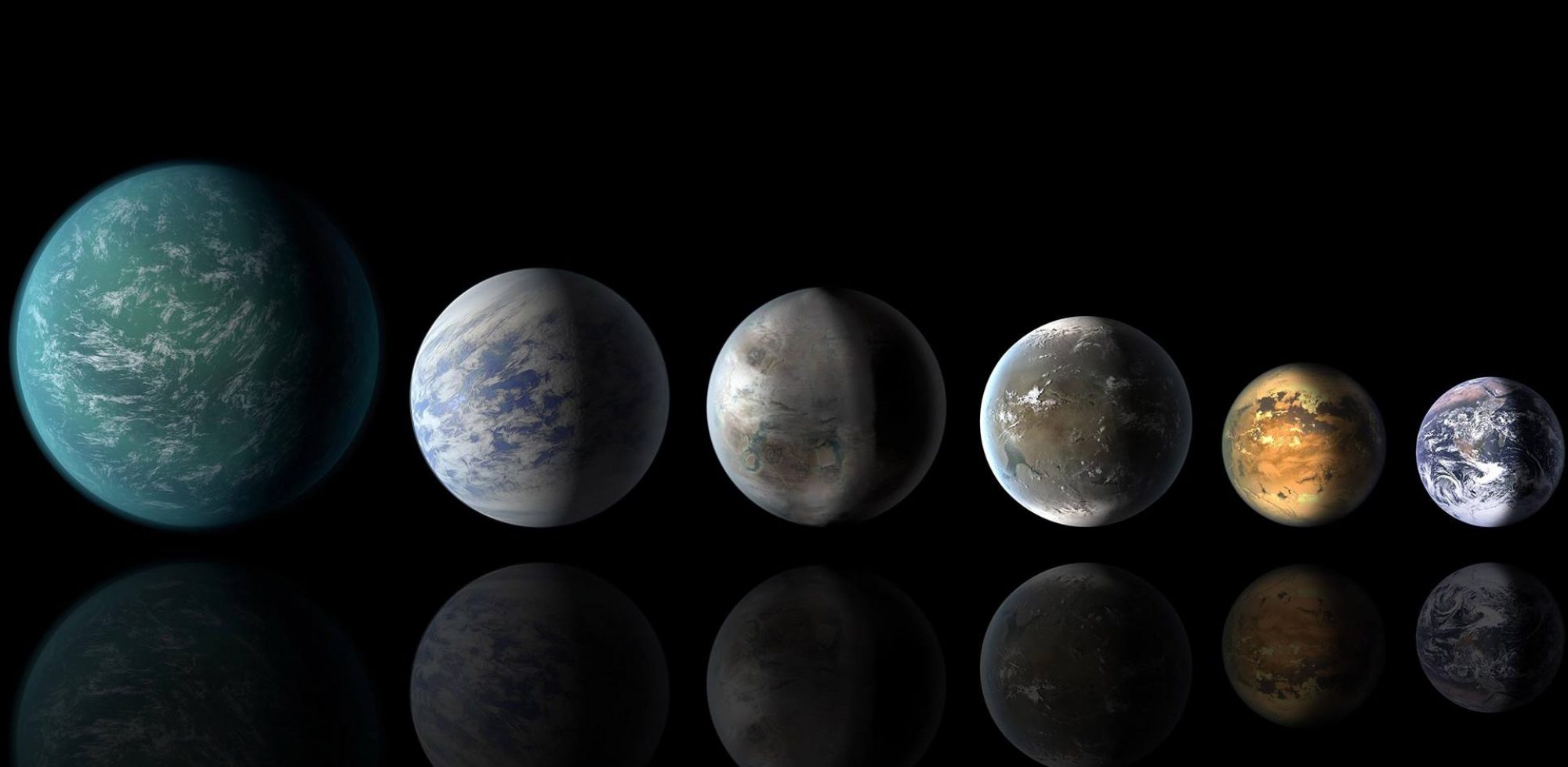
What Would Happen If Mars And Venus Swapped Places?

  What would happen if you switched the orbits of Mars and Venus? Would our solar system have more habitable worlds? It was a question raised at the “Comparative Climatology of Terrestrial Planets III”; a meeting held in Houston at the end of August. It brought together scientists from disciplines that included astronomers, climate science, …

Prepare For Lift-off! BepiColombo Launches For Mercury

This Friday (October 19) at 10:45pm local time in French Guinea, a spacecraft is set to launch for Mercury. This is the BepiColombo mission which will begin its seven year journey to our solar system’s innermost planet. Surprisingly, the science goals for investigating this boiling hot world are intimately linked to habitability. Mercury orbits the …

Asteroid Remains Around Dead Stars Reveal the Likely Fate of Our Solar System

June 30th has been designated “Asteroid Day” to promote awareness of these small members of our solar system. But while asteroids are often discussed in the context of the risk they might pose to the Earth, their chewed up remains around other stars may also reveal the fate of our solar system. It is 6.5 …

Know Thy Star, Know Thy Planet: How Gaia is Helping Nail Down Planet Sizes

Last month, the European Space Agency's Gaia mission released the most accurate catalogue to date of positions and motions for a staggering 1.3 billion stars. Let’s do a few comparisons so we can be suitably amazed. The total number of stars you can see without a telescope is less than 10,000. This includes visible stars …

NASA’s Planet-Hunter TESS Has Just Been Launched to Check Out the Near Exoplanet Neighborhood

A SpaceX Falcon 9 rocket transporting the TESS satellite lifts off from launch complex 40 at the Cape Canaveral Air Force Station in Cape Canaveral, Fla., Wednesday, April 18, 2018. The space telescope will survey almost the entire sky, staring at the brightest, closest stars in an effort to find any planets that might be …

The Just-Approved European ARIEL Mission Will Be First Dedicated to Probing Exoplanet Atmospheres

  The European Space Agency (ESA) has approved the ARIEL space mission—the world's first dedicated exoplanet atmosphere sniffer— to fly in 2028. ARIEL stands for the “Atmospheric Remote-sensing Infrared Exoplanet Large-Survey mission.” It is a space telescope that can detect which atoms and molecules are present in the atmosphere of an exoplanet. The mission was …

Artificial Intelligence Has Just Found Two Exoplanets: What Does This Mean For Planet Hunting?

The media was abuzz last week with the latest NASA news conference. A neural network -- a form of artificial intelligence or machine learning -- developed at Google had found two planets in data previously collected by NASA’s prolific Kepler Space Telescope. It’s a technique that could ultimately track-down our most Earth-like planets. The new …

Phobos and Deimos: Captured Asteroids or Cut From Ancient Mars?

Illustration of Mars with its two moons, Phobos and Deimos. (NASA/JPL-Caltech/Malin Space Science Systems/Texas A&M Univ.) The global success rate for sending missions to land on the moons of Mars has hardly been impressive -- coming in at zero out of three attempts.  They were all led by the Russian (or former Soviet) space agencies, …